Get your patient on Furosemide
Furosemide prescribing information

INDICATIONS
Dogs and Cats
Furosemide Tablets are an effective diuretic possessing a wide therapeutic range. Pharmacologically it promotes the rapid removal of abnormally retained extracellular fluids. The rationale for the efficacious use of diuretic therapy is determined by the clinical pathology producing the edema. Furosemide Tablets are indicated for the treatment of edema (pulmonary congestion, ascites) associated with cardiac insufficiency and acute noninflammatory tissue edema.
The continued use of heart stimulants, such as digitalis or its glycosides is indicated in cases of edema involving cardiac insufficiency.
DOSAGE AND ADMINISTRATION
The usual dosage of furosemide is 1 to 2 mg/lb. body weight (approximately 2.5 to 5 mg/kg). The lower dosage is suggested for cats. Administer once or twice daily at 6 to 8 hour intervals either orally, intravenously, or intramuscularly. A prompt diuresis usually ensues from the initial treatment. Diuresis may be initiated by the parenteral administration of furosemide injection and then maintained by oral administration.
The dosage should be adjusted to the individual's response. In severe edematous or refractory cases, the dose may be doubled or increased by increments of 1 mg per pound body weight. The established effective dose should be administered once or twice daily. The daily schedule of administration can be timed to control the period of micturition for the convenience of the client or veterinarian.
Mobilization of the edema may be most efficiently and safely accomplished by utilizing an intermittent daily dosage schedule, i.e. every other day or 2 to 4 consecutive days weekly.
Diuretic therapy should be discontinued after reduction of the edema, or maintained after determining a carefully programmed dosage schedule to prevent recurrence of edema. For long-term treatment, the dose can generally be lowered after the edema has once been reduced. Re-examination and consultations with client will enhance the establishment of a satisfactorily programmed dosage schedule. Clinical examination and serum BUN, CO2 and electrolyte determinations should be performed during the early period of therapy and periodically thereafter, especially in refractory cases. Abnormalities should be corrected or the drug temporarily withdrawn.
CONTRAINDICATIONS - PRECAUTIONS
Furosemide Tablets are a highly effective diuretic-saluretic which if given in excessive amounts may result in dehydration and electrolyte imbalance. Therefore, the dosage and schedule may have to be adjusted to the patient's needs. The animal should be observed for early signs of electrolyte imbalance, and corrective measures administered. Early signs of electrolyte imbalance are: increased thirst, lethargy, drowsiness or restlessness, fatigue, oliguria, gastro-intestinal disturbances and tachycardia.
Special attention should be given to potassium levels. Furosemide Tablets may lower serum calcium levels and cause tetany in rare cases of animals having an existing hypocalcemic tendency.
Although diabetes mellitus is a rarely reported disease in animals, active or latent diabetes mellitus may on rare occasions be exacerbated by Furosemide Tablets. While it has not been reported in animals the use of high doses of salicylates, as in rheumatic diseases, in conjunction with Furosemide Tablets may result in salicylate toxicity because of competition for renal excretory sites.
Transient loss of auditory capacity has been experimentally produced in cats following intravenous injection of excessive doses of furosemide at a very rapid rate.
Electrolyte balance should be monitored prior to surgery in patients receiving Furosemide Tablets. Imbalances must be corrected by administration of suitable fluid therapy.
Furosemide Tablets are contraindicated in anuria. Therapy should be discontinued in cases of progressive renal disease if increasing azotemia and oliguria occur during the treatment. Sudden alterations of fluid and electrolyte imbalance in an animal with cirrhosis may precipitate hepatic coma, therefore observation during period of therapy is necessary. In hepatic coma and in states of electrolyte depletion, therapy should not be instituted until the basic condition is improved or corrected. Potassium supplementation may be necessary in cases routinely treated with potassium-depleting steroids.
DESCRIPTION
Furosemide Tablets are a chemically distinct diuretic and saluretic pharmacodynamically characterized by the following:
1) A high degree of efficacy, low-inherent toxicity and a high therapeutic index.
2) A rapid onset of action and of comparatively short duration.
3) A pharmacological action in the functional area of the nephron, i.e., proximal and distal tubules and the ascending limb of the loop of Henle.
4) A dose-response relationship and a ratio of minimum to maximum effective dose range greater than tenfold.
5) It may be administered orally or parenterally.
It is readily absorbed from the intestinal tract and well tolerated.
The intravenous route produces the most rapid diuretic response.
The CAS Registry Number is 54-31-9.
Furosemide Tablets, a diuretic, is an anthranilic acid derivative with the following structural formula:
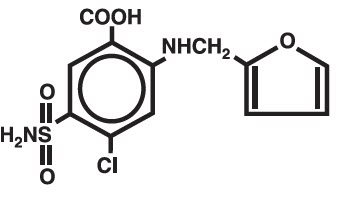
Generic name: Furosemide (except in United Kingdom-furosemide).
Chemical name: 4-chloro-N-furfuryl-5-sulfamoylanthranilic acid.
HOW SUPPLIED
Tablets:
50 mg (scored) tablets
Each tablet contains 50.0 milligrams of furosemide: 4-chloro-N-furfuryl-5-sulfamoylanthranilic acid.
12.5 mg tablets
Each tablet contains 12.5 milligrams of furosemide: 4-chloro-N-furfuryl-5-sulfamoylanthranilic acid.
Available in bottles of 500 tablets.
