Get your patient on Icosapent Ethyl - Icosapent Ethyl capsule (Icosapent Ethyl)
Icosapent Ethyl - Icosapent Ethyl capsule prescribing information

INDICATIONS AND USAGE
Icosapent ethyl capsules are indicated:
- as an adjunct to diet to reduce triglyceride (TG) levels in adult patients with severe (≥500 mg/dL) hypertriglyceridemia.
Limitations of Use:
The effect of icosapent ethyl capsules on the risk for pancreatitis in patients with severe hypertriglyceridemia has not been determined.
DOSAGE AND ADMINISTRATION
Prior to Initiation of Icosapent Ethyl Capsules
- Assess lipid levels before initiating therapy. Identify other causes (e.g., diabetes mellitus, hypothyroidism, or medications) of high triglyceride levels and manage as appropriate.
- Patients should engage in appropriate nutritional intake and physical activity before receiving icosapent ethyl capsules, which should continue during treatment with icosapent ethyl capsules.
2.2 Dosage and Administration
- The daily dose of icosapent ethyl capsules is 4 grams per day taken as:
- two 1 gram capsules twice daily with food.
- Advise patients to swallow icosapent ethyl capsules whole. Do not break open, crush, dissolve, or chew icosapent ethyl capsules.
DOSAGE FORMS AND STRENGTHS
Icosapent ethyl capsules are supplied as:
- 1 gram oblong, natural colored transparent soft gelatin capsules with the logo “A1000” printed in white ink.
USE IN SPECIFIC POPULATIONS
Pregnancy
Risk Summary
The available data from published case reports and the pharmacovigilance database on the use of icosapent ethyl capsules in pregnant women are insufficient to identify a drug-associated risk for major birth defects, miscarriage or adverse maternal or fetal outcomes. In animal reproduction studies in pregnant rats, non-dose-related imbalances for some minor developmental findings were observed with oral administration of icosapent ethyl during organogenesis at exposures that were equivalent to the clinical exposure at the human dose of 4 g/day, based on body surface area comparisons. In a study in pregnant rabbits orally administered icosapent ethyl during organogenesis, there were no clinically relevant adverse developmental effects at exposures that were 5 times the clinical exposure, based on body surface area comparisons (see Data) .
The estimated background risk of major birth defects and miscarriage for the indicated population is unknown. All pregnancies have a background risk of birth defect, loss, or other adverse outcomes. In the U.S. general population, the estimated background risk of major birth defects and miscarriage in clinically recognized pregnancies is 2-4% and 15-20%, respectively.
Data
Animal Data
In pregnant rats given oral gavage doses of 0.3, 1 and 2 g/kg/day icosapent ethyl from gestation through organogenesis all drug treated groups had non-dose-related imbalances in visceral and skeletal findings, including 13 th reduced ribs, additional liver lobes, testes medially displaced and/or not descended at human systemic exposures following a maximum oral dose of 4 g/day based on body surface comparisons.
In a multigenerational developmental study in pregnant rats given doses of 0.3, 1, 3 g/kg/day icosapent ethyl by oral gavage from gestation day 7-17, icosapent ethyl did not affect viability in fetuses (F1 or F2). Non-dose-related imbalances in findings of absent optic nerves and unilateral testes atrophy at human exposures based on the maximum dose of 4 g/day and on body surface area comparisons. Additional variations consisting of early incisor eruption and increased percent cervical ribs were observed at the same exposures. Pups from high dose treated dams exhibited decreased copulation rates, delayed estrus, decreased implantations and decreased surviving fetuses (F2) suggesting potential multigenerational effects of icosapent ethyl at 7 times human systemic exposure following 4 g/day dose based on body surface area comparisons across species.
In pregnant rabbits given oral gavage doses of 0.1, 0.3, and 1 g/kg/day icosapent ethyl from gestation through organogenesis, a decrease in body weight and food consumption was observed at the high dose of 1 g/kg/day (5 times the human exposure at the maximum dose of 4 g/day, based on body surface area comparisons). Slight increases in resorbed and dead fetuses were noted in the 1 g/kg/day group, but these were not significantly different from the control group. There were no differences between the icosapent ethyl groups and control group as to the number of corpora lutea, number of implantations, number of surviving fetuses, sex ratio, body weight of female fetuses or placental weight. There were no treatment-related malformations or skeletal anomalies.
In pregnant rats given icosapent ethyl from gestation day 17 through lactation day 20 at 0.3, 1, 3 g/kg/day no adverse maternal or developmental effects were observed. However, complete litter loss (not dose-related) was noted in 2/23 litters at the low dose and 1/23 mid-dose dams by post-natal day 4 at human exposures at a maximum dose of 4 g/day, based on body surface area comparisons.
Lactation
Risk Summary
Published studies have detected omega-3 fatty acids, including EPA, in human milk. Lactating women receiving oral omega-3 fatty acids for supplementation have resulted in higher levels of omega-3 fatty acids in human milk. There are no data on the effects of omega-3 fatty acid ethyl esters on the breastfed infant or on milk production. The developmental and health benefits of breastfeeding should be considered along with the mother’s clinical need for icosapent ethyl capsules and any potential adverse effects on the breastfed child from icosapent ethyl or from the underlying maternal condition.
Pediatric Use
Safety and effectiveness in pediatric patients have not been established.
Geriatric Use
Of the total number of patients in well-controlled clinical studies of icosapent ethyl, 45% were 65 years of age and over. No overall differences in safety or effectiveness were observed between these patients and younger groups. Other reported clinical experience has not identified differences in responses between the elderly and younger patients.
Hepatic Impairment
In patients with hepatic impairment, alanine aminotransferase (ALT) and aspartate aminotransferase (AST) levels should be monitored periodically during therapy with icosapent ethyl capsules.
CONTRAINDICATIONS
Icosapent ethyl capsules are contraindicated in patients with known hypersensitivity (e.g., anaphylactic reaction) to icosapent ethyl or any of its components.
WARNINGS AND PRECAUTIONS
Atrial Fibrillation/Flutter: Icosapent ethyl capsules were associated with an increased risk of atrial fibrillation or atrial flutter requiring hospitalization in a double-blind placebo-controlled trial. The incidence of atrial fibrillation was greater in patients with a previous history of atrial fibrillation or atrial flutter. (5.1 )
Potential for Allergic Reactions in Patients with Fish Allergy: Icosapent ethyl capsules contains ethyl esters of the omega-3 fatty acid, eicosapentaenoic acid (EPA), obtained from the oil of fish. It is not known whether patients with allergies to fish and/or shellfish are at increased risk of an allergic reaction to icosapent ethyl capsules. Inform patients with known hypersensitivity to fish and/or shellfish about the potential for allergic reactions and advise them to discontinue icosapent ethyl capsules and seek medical attention if any reactions occur. (5.2 )
Bleeding: Icosapent ethyl capsules were associated with an increased risk of bleeding in a double-blind, placebo-controlled trial. The incidence of bleeding was greater in patients receiving concomitant antithrombotic medications, such as aspirin, clopidogrel, or warfarin. (5.3 )
Atrial Fibrillation/Flutter
Icosapent ethyl capsules are associated with an increased risk of atrial fibrillation or atrial flutter requiring hospitalization. In a double-blind, placebo-controlled trial of 8,179 subjects, adjudicated atrial fibrillation or atrial flutter requiring hospitalization for 24 or more hours occurred in 127 (3%) patients treated with icosapent ethyl capsules compared to 84 (2%) patients receiving placebo [HR=1.5 (95% CI 1.14, 1.98)]. The incidence of atrial fibrillation was greater in patients with a previous history of atrial fibrillation or atrial flutter.
Potential for Allergic Reactions in Patients with Fish Allergy
Icosapent ethyl capsules contain ethyl esters of the omega-3 fatty acid, eicosapentaenoic acid (EPA), obtained from the oil of fish. It is not known whether patients with allergies to fish and/or shellfish are at increased risk of an allergic reaction to icosapent ethyl capsules. Inform patients with known hypersensitivity to fish and/or shellfish about the potential for allergic reactions to icosapent ethyl capsules and advise them to discontinue icosapent ethyl capsules and seek medical attention if any reactions occur.
Bleeding
Icosapent ethyl capsules are associated with an increased risk of bleeding. In a double-blind, placebo-controlled trial of 8,179 patients, 482 (12%) patients receiving icosapent ethyl capsules experienced a bleeding event compared to 404 (10%) patients receiving placebo. Serious bleeding events occurred in 111 (3%) of patients on icosapent ethyl capsules vs. 85 (2%) of patients receiving placebo. The incidence of bleeding was greater in patients receiving concomitant antithrombotic medications, such as aspirin, clopidogrel, or warfarin.
ADVERSE REACTIONS
The following important adverse reactions are described below and elsewhere in the labeling:
- Atrial Fibrillation or Atrial Flutter [see Warnings and Precautions (5.1)]
- Potential for Allergic Reactions in Patients with Fish Allergy [see Warnings and Precautions (5.2)]
- Bleeding [see Warnings and Precautions (5.3)]
Clinical Trials Experience
Because clinical trials are conducted under widely varying conditions, adverse reaction rates observed in the clinical trials of a drug cannot be directly compared to rates in the clinical trials of another drug and may not reflect the rates observed in practice.
Common adverse reactions (incidence ≥3% on icosapent ethyl capsules and ≥1% more frequent than placebo) included musculoskeletal pain, peripheral edema, constipation, gout, and atrial fibrillation.
Hypertriglyceridemia Trials
In two randomized, double-blind, placebo-controlled trials in patients with triglyceride levels between 200 and 2000 mg/dL treated for 12 weeks, adverse reactions reported with icosapent ethyl capsules at an incidence ≥1% more frequent than placebo based on pooled data included arthralgia and oropharyngeal pain.
Postmarketing Experience
Additional adverse reactions have been identified during post-approval use of icosapent ethyl capsules. Because these reactions are reported voluntarily from a population of uncertain size, it is generally not possible to reliably estimate their frequency or establish a causal relationship to drug exposure.
- Diarrhea
- Blood triglycerides increased
- Abdominal discomfort
- Pain in the extremities
DRUG INTERACTIONS
Increased Bleeding Risk with Anticoagulants and Antiplatelet Agents: Some published studies with omega-3 fatty acids have demonstrated prolongation of bleeding time. Monitor patients receiving icosapent ethyl capsules and concomitant anticoagulants and/or antiplatelet agents for bleeding. (7 )
Increased Bleeding Risk with Anticoagulants and Antiplatelet Agents
Some published studies with omega-3 fatty acids have demonstrated prolongation of bleeding time. The prolongation of bleeding time reported in those studies has not exceeded normal limits and did not produce clinically significant bleeding episodes. Monitor patients receiving icosapent ethyl capsules and concomitant anticoagulants and/or antiplatelet agents for bleeding.
DESCRIPTION
Icosapent ethyl, a lipid-regulating agent, is supplied as a 1 gram oblong, natural colored transparent soft gelatin capsule for oral administration.
Each icosapent ethyl capsule contains 1 gram of icosapent ethyl. Icosapent ethyl is an ethyl ester of the omega-3 fatty acid eicosapentaenoic acid (EPA). The molecular formula of icosapent ethyl is C 22 H 34 O 2 and the molecular weight is 330.5 g/mol. The chemical name for icosapent ethyl is ethyl (5Z,8Z,11Z,14Z,17Z)-icosa-5,8,11,14,17-pentaenoate with the following chemical structure:
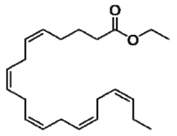
Icosapent ethyl capsules (1 gram capsules) also contain the following inactive ingredients: gelatin, glycerine, purified water and tocopherol. The capsule imprinting ink contains ammonium hydroxide, propylene glycol, shellac, simethicone, and titanium dioxide.
CLINICAL PHARMACOLOGY
Mechanism of Action
Studies suggest that EPA reduces hepatic very low-density lipoprotein triglycerides (VLDL-TG) synthesis and/or secretion and enhances TG clearance from circulating VLDL particles. Potential mechanisms of action include increased β-oxidation; inhibition of acyl-CoA:1,2-diacylglycerol acyltransferase (DGAT); decreased lipogenesis in the liver; and increased plasma lipoprotein lipase activity.
12.2 Pharmacodynamics
In a 12-week, dose-ranging study in patients with severe hypertriglyceridemia, icosapent ethyl capsules 4 grams per day reduced median TG from baseline relative to placebo [see Clinical Studies (14)].
Pharmacokinetics
Absorption
After oral administration, icosapent ethyl is de-esterified during the absorption process and the active metabolite EPA is absorbed in the small intestine and enters the systemic circulation mainly via the thoracic duct lymphatic system. Peak plasma concentrations of EPA were reached approximately 5 hours following oral doses of icosapent ethyl.
Icosapent ethyl was administered with or following a meal in all clinical studies; no food effect studies were performed. Take icosapent ethyl capsules with or following a meal.
Distribution
The mean volume of distribution at steady-state of EPA is approximately 88 liters. The majority of EPA circulating in plasma is incorporated in phospholipids, triglycerides and cholesteryl esters, and <1% is present as the unesterified fatty acid. Greater than 99% of unesterified EPA is bound to plasma proteins.
Elimination
Metabolism
EPA is mainly metabolized by the liver via beta-oxidation similar to dietary fatty acids. Beta oxidation splits the long carbon chain of EPA into acetyl Coenzyme A, which is converted into energy via the Krebs cycle. Cytochrome P450-mediated metabolism is a minor pathway of elimination of EPA.
Excretion
The total plasma clearance of EPA at steady state is 684 mL/hr. The plasma elimination half-life (t 1/2 ) of EPA is approximately 89 hours. Icosapent ethyl does not undergo renal excretion.
Specific Populations
Gender
When administered icosapent ethyl in clinical trials, plasma total EPA concentrations did not differ significantly between men and women.
Pediatric
The pharmacokinetics of icosapent ethyl have not been studied in pediatric patients.
Hepatic or Renal Impairment
Icosapent ethyl has not been studied in patients with renal or hepatic impairment.
Drug Interaction Studies
Omeprazole:
In a drug-drug interaction study with 28 healthy adult subjects, icosapent ethyl 4 g/day at steady-state did not significantly change the steady-state AUC τ or C max of omeprazole when co-administered at 40 mg/day to steady-state.
Rosiglitazone:
In a drug-drug interaction study with 28 healthy adult subjects, icosapent ethyl 4 g/day at steady-state did not significantly change the single dose AUC or C max of rosiglitazone at 8 mg.
Warfarin:
In a drug-drug interaction study with 25 healthy adult subjects, icosapent ethyl 4 g/day at steady-state did not significantly change the single dose AUC or C max of R- and S- warfarin or the anti-coagulation pharmacodynamics of warfarin when co-administered as racemic warfarin at 25 mg.
Atorvastatin:
In a drug-drug interaction study of 26 healthy adult subjects, icosapent ethyl 4 g/day at steady-state did not significantly change the steady-state AUC τ or C max of atorvastatin, 2-hydroxyatorvastatin, or 4-hydroxyatorvastatin when co-administered with atorvastatin 80 mg/day at steady-state.
NONCLINICAL TOXICOLOGY
Carcinogenesis, Mutagenesis, Impairment of Fertility
In a 2-year rat carcinogenicity study with oral gavage doses of 0.09, 0.27, and 0.91 g/kg/day icosapent ethyl, respectively, males did not exhibit drug-related neoplasms. Hemangiomas and hemangiosarcomas of the mesenteric lymph node, the site of drug absorption, were observed in females at clinically relevant exposures based on body surface area comparisons across species relative to the maximum clinical dose of 4 g/day. Overall incidence of hemangiomas and hemangiosarcomas in all vascular tissues did not increase with treatment.
In a 6-month carcinogenicity study in Tg.rasH2 transgenic mice with oral gavage doses of 0.5, 1, 2, and 4.6 g/kg/day icosapent ethyl, drug-related incidences of benign squamous cell papilloma in the skin and subcutis of the tail was observed in high dose male mice. The papillomas were considered to develop secondary to chronic irritation of the proximal tail associated with fecal excretion of oil and therefore not clinically relevant. Drug-related neoplasms were not observed in female mice.
Icosapent ethyl was not mutagenic with or without metabolic activation in the bacterial mutagenesis (Ames) assay or in the in vivo mouse micronucleus assay. A chromosomal aberration assay in Chinese Hamster Ovary (CHO) cells was positive for clastogenicity with and without metabolic activation.
In an oral gavage rat fertility study, ethyl-EPA, administered at doses of 0.3, 1, and 3 g/kg/day to male rats for 9 weeks before mating and to female rats for 14 days before mating through day 7 of gestation, increased anogenital distance in female pups and increased cervical ribs were observed at 3 g/kg/day (7 times human systemic exposure with 4 g/day clinical dose based on a body surface area comparison).
CLINICAL STUDIES
Severe Hypertriglyceridemia
The effects of icosapent ethyl 4 grams per day were assessed in a randomized, placebo- controlled, double-blind, parallel-group study of adult patients (76 on icosapent ethyl, 75 on placebo) with severe hypertriglyceridemia. Patients whose baseline TG levels were between 500 and 2,000 mg/dL were enrolled in this study for 12 weeks. The median baseline TG and LDL-C levels in these patients were 684 mg/dL and 86 mg/dL, respectively. Median baseline HDL-C level was 27 mg/dL. The randomized population in this study was mostly Caucasian (88%) and male (76%). The mean age was 53 years and the mean body mass index was 31 kg/m 2 . Twenty-five percent of patients were on concomitant statin therapy, 28% were diabetics, and 39% of the patients had TG levels >750 mg/dL. The changes in the major lipoprotein lipid parameters for the groups receiving icosapent ethyl or placebo are shown in Table 2 .
Table 2. Median Baseline and Percent Change from Baseline in Lipid Parameters in Patients with Severe Hypertriglyceridemia (≥500 mg/dL)
| Parameter | Icosapent Ethyl 4 g/day N=76 | Placebo N=75 | Difference (95% Confidence Interval) | ||
| Baseline | % Change | Baseline | % Change | ||
| TG (mg/dL) | 680 | -27 | 703 | +10 | -33 • (-47, -22) |
| LDL-C (mg/dL) | 91 | -5 | 86 | -3 | -2 (-13, +8) |
| Non-HDL-C (mg/dL) | 225 | -8 | 229 | +8 | -18 (-25, -11) |
| TC (mg/dL) | 254 | -7 | 256 | +8 | -16 (-22, -11) |
| HDL-C (mg/dL) | 27 | -4 | 27 | 0 | -4 (-9, +2) |
| VLDL-C (mg/dL) | 123 | -20 | 124 | +14 | -29 •• (-43, -14) |
| Apo B (mg/dL) | 121 | -4 | 118 | +4 | -9 •• (-14, -3) |
% Change= Median Percent Change from Baseline
Difference= Median of [icosapent ethyl % Change – Placebo % Change] (Hodges-Lehmann Estimate) p-values from Wilcoxon rank-sum test
• p-value < 0.001 (primary efficacy endpoint)
•• p-value < 0.05 (key secondary efficacy endpoints determined to be statistically significant according to the pre-specified multiple comparison procedure)
Icosapent ethyl 4 grams per day reduced median TG, VLDL-C, and Apo B levels from baseline relative to placebo. The reduction in TG observed with icosapent ethyl was not associated with elevations in LDL-C levels relative to placebo.
HOW SUPPLIED/STORAGE AND HANDLING
Icosapent ethyl capsules are supplied as 1 gram oblong, natural colored transparent soft gelatin capsules with the logo “A1000” printed in white ink.
Bottles of 120: NDC 60505-4033-1.
Store at 20°C to 25° C (68°F to 77°F); excursions permitted from 15°C to 30° C (59°F to 86°F) [see USP Controlled Room Temperature].
Mechanism of Action
Studies suggest that EPA reduces hepatic very low-density lipoprotein triglycerides (VLDL-TG) synthesis and/or secretion and enhances TG clearance from circulating VLDL particles. Potential mechanisms of action include increased β-oxidation; inhibition of acyl-CoA:1,2-diacylglycerol acyltransferase (DGAT); decreased lipogenesis in the liver; and increased plasma lipoprotein lipase activity.
