Get your patient on Isoflurane - Isoflurane liquid (Isoflurane)
Isoflurane - Isoflurane liquid prescribing information

INDICATIONS AND USAGE
Isoflurane may be used for induction and maintenance of general anesthesia. Adequate data have not been developed to establish its application in obstetrical anesthesia.
DOSAGE AND ADMINISTRATION
Premedication
Premedication should be selected according to the need of the individual patient, taking into account that secretions are weakly stimulated by isoflurane and the heart rate tends to be increased. The use of anticholinergic drugs is a matter of choice.
Inspired Concentration
The concentration of isoflurane being delivered from a vaporizer during anesthesia should be known. This may be accomplished by using:
- vaporizers calibrated specifically for isoflurane;
- vaporizers from which delivered flows can be calculated, such as vaporizers delivering a saturated vapor which is then diluted. The delivered concentration from such a vaporizer may be calculated using the formula:
| % isoflurane | = | 100 P V F V ––––––––– | |
| F T (P A -P V ) | |||
| Where: | P A | = | Pressure of atmosphere |
| P V | = | Vapor pressure of isoflurane | |
| F V | = | Flow of gas through vaporizer (mL/min) | |
| F T | = | Total gas flow (mL/min) | |
Isoflurane contains no stabilizer. Nothing in the agent alters calibration or operation of these vaporizers.
Induction
Induction with isoflurane in oxygen or in combination with oxygen-nitrous oxide mixtures may produce coughing, breath holding, or laryngospasm. These difficulties may be avoided by the use of a hypnotic dose of an ultra-short-acting barbiturate. Inspired concentrations of 1.5 to 3.0% isoflurane usually produce surgical anesthesia in 7 to 10 minutes.
Maintenance
Surgical levels of anesthesia may be sustained with a 1.0 to 2.5% concentration when nitrous oxide is used concomitantly. An additional 0.5 to 1.0% may be required when isoflurane is given using oxygen alone. If added relaxation is required, supplemental doses of muscle relaxants may be used.
The level of blood pressure during maintenance is an inverse function of isoflurane concentration in the absence of other complicating problems. Excessive decreases may be due to depth of anesthesia and in such instances may be corrected by lightening anesthesia.
CONTRAINDICATIONS
Known sensitivity to isoflurane, or to other halogenated agents.
Known or suspected genetic susceptibility to malignant hyperthermia.
ADVERSE REACTIONS
Adverse reactions encountered in the administration of isoflurane are in general dose dependent extensions of pharmacophysiologic effects and include respiratory depression, hypotension and arrhythmias.
Shivering, nausea, vomiting and ileus have been observed in the postoperative period.
As with all other general anesthetics, transient elevations in white blood count have been observed even in the absence of surgical stress. See WARNINGS for information regarding malignant hyperthermia and elevated carboxyhemoglobin levels. During marketing, there have been rare reports of mild, moderate and severe (some fatal) post-operative hepatic dysfunction and hepatitis.
Isoflurane has also been associated with perioperative hyperkalemia (see WARNINGS ).
Post-Marketing Events
The following adverse events have been identified during post-approval use of isoflurane, USP. Due to the spontaneous nature of these reports, the actual incidence and relationship of isoflurane, USP to these events cannot be established with certainty.
Cardiac Disorders : Cardiac arrest
Hepatobiliary Disorders : Hepatic necrosis, Hepatic failure.
Drug Interactions
Isoflurane potentiates the muscle relaxant effect of all muscle relaxants, most notably nondepolarizing muscle relaxants, and MAC (minimum alveolar concentration) is reduced by concomitant administration of N 2 O. See CLINICAL PHARMACOLOGY .
DESCRIPTION
Isoflurane, USP, a nonflammable liquid administered by vaporizing, is a general inhalation anesthetic drug. It is 1-chloro-2,2,2-trifluoroethyl difluoromethyl ether, and its structural formula is:
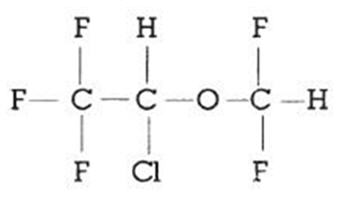
Some physical constants are:
| Molecular weight | 184.5 | |
| Boiling point at 760 mm Hg | 48.5°C (uncorr.) | |
| Refractive index n 20 D | 1.2990-1.3005 | |
| Specific gravity 25° / 25°C | 1.496 | |
| Vapor pressure in mm Hg Equation for vapor pressure calculation: | 20°C | 238 |
| 25ºC | 295 | |
| 30°C | 367 | |
| 35°C | 450 | |
| Log 10 P vap = | A + B T | where: | A=8.056 B=-1664.58 T=°C = 273.16 (Kelvin |
Partition coefficients at 37°C:
| Water / gas | 0.61 |
| Blood / gas | 1.43 |
| Oil / gas | 90.8 |
Partition coefficients at 25°C - rubber and plastic
| Conductive rubber / gas | 62.0 |
| Butyl rubber / gas | 75.0 |
| Polyvinyl chloride / gas | 110.0 |
| Polyethylene / gas | ~2.0 |
| Polyurethane / gas | ~1.4 |
| Polyolefin / gas | ~1.1 |
| Butyl acetate / gas | ~2.5 |
| Purity by gas chromatography | >99.9% |
| Lower limit of flammability in oxygen or nitrous oxide at 9 joules/sec. and 23ºC | None |
| Lower limit of flammability in oxygen or nitrous oxide at 900 joules/sec. and 23ºC | Greater than useful concentration in anesthesia |
Isoflurane is a clear, colorless, stable liquid containing no additives or chemical stabilizers. Isoflurane has a mildly pungent, musty, ethereal odor. Samples stored in indirect sunlight in clear, colorless glass for five years, as well as samples directly exposed for 30 hours to a 2 amp, 115 volt, 60 cycle long wave U.V. light were unchanged in composition as determined by gas chromatography. Isoflurane in one normal sodium methoxide-methanol solution, a strong base, for over six months consumed essentially no alkali, indicative of strong base stability. Isoflurane does not decompose in the presence of soda lime (at normal operating temperatures), and does not attack aluminum, tin, brass, iron, or copper.
CLINICAL PHARMACOLOGY
Isoflurane is an inhalation anesthetic. The MAC (minimum alveolar concentration) in man is as follows:
| Age | 100% Oxygen | 70% N 2 O |
|---|---|---|
| 26 ± 4 | 1.28 | 0.56 |
| 44 ± 7 | 1.15 | 0.50 |
| 64 ± 5 | 1.05 | 0.37 |
Induction of and recovery from isoflurane anesthesia are rapid. Isoflurane has a mild pungency which limits the rate of induction, although excessive salivation or tracheobronchial secretions do not appear to be stimulated. Pharyngeal and laryngeal reflexes are readily obtunded. The level of anesthesia may be changed rapidly with isoflurane. Isoflurane is a profound respiratory depressant. RESPIRATION MUST BE MONITORED CLOSELY AND SUPPORTED WHEN NECESSARY. As anesthetic dose is increased, tidal volume decreases and respiratory rate is unchanged. This depression is partially reversed by surgical stimulation, even at deeper levels of anesthesia. Isoflurane evokes a sigh response reminiscent of that seen with diethyl ether and enflurane, although the frequency is less than with enflurane.
Blood pressure decreases with induction of anesthesia but returns toward normal with surgical stimulation. Progressive increases in depth of anesthesia produce corresponding decreases in blood pressure. Nitrous oxide diminishes the inspiratory concentration of isoflurane required to reach a desired level of anesthesia and may reduce the arterial hypotension seen with isoflurane alone. Heart rhythm is remarkably stable. With controlled ventilation and normal PaCO 2 , cardiac output is maintained despite increasing depth of anesthesia primarily through an increase in heart rate which compensates for a reduction in stroke volume. The hypercapnia which attends spontaneous ventilation during isoflurane anesthesia further increases heart rate and raises cardiac output above awake levels. Isoflurane does not sensitize the myocardium to exogenously administered epinephrine in the dog. Limited data indicate that subcutaneous injection of 0.25mg of epinephrine (50 mL of 1:200,000 solution) does not produce an increase in ventricular arrhythmias in patients anesthetized with isoflurane.
Muscle relaxation is often adequate for intra-abdominal operations at normal levels of anesthesia. Complete muscle paralysis can be attained with small doses of muscle relaxants. ALL COMMONLY USED MUSCLE RELAXANTS ARE MARKEDLY POTENTIATED WITH ISOFLURANE, THE EFFECT BEING MOST PROFOUND WITH THE NONDEPOLARIZING TYPE. Neostigmine reverses the effect of nondepolarizing muscle relaxants in the presence of isoflurane. All commonly used muscle relaxants are compatible with isoflurane.
Isoflurane can produce coronary vasodilation at the arteriolar level in selected animal models; the drug is probably also a coronary dilator in humans. Isoflurane, like some other coronary arteriolar dilators, has been shown to divert blood from collateral dependent myocardium to normally perfused areas in an animal model ("coronary steal"). Clinical studies to date evaluating myocardial ischemia, infarction and death as outcome parameters have not established that the coronary arteriolar dilation property of isoflurane is associated with coronary steal or myocardial ischemia in patients with coronary artery disease.
Pharmacokinetics
Isoflurane undergoes minimal biotransformation in man. In the postanesthesia period, only 0.17% of the isoflurane taken up can be recovered as urinary metabolites.
HOW SUPPLIED
Isoflurane, USP is available in unit packages of 100 mL (NDC 12164-012-10) and 250 mL (NDC 12164-012-25) amber colored bottles.
Safety and Handling
Occupational Caution
There is no specific work exposure limit established for isoflurane, USP. However, the National Institute for Occupational Safety and Health Administration (NIOSH) recommends that no worker should be exposed at ceiling concentrations greater than 2 ppm of any halogenated anesthetic agent over a sampling period not to exceed one hour.
The predicted effects of acute overexposure by inhalation of isoflurane, USP include headache, dizziness or (in extreme cases) unconsciousness. There are no documented adverse effects of chronic exposure to halogenated anesthetic vapors (Waste Anesthetic Gases or WAGs) in the workplace. Although results of some epidemiological studies suggest a link between exposure to halogenated anesthetics and increased health problems (particularly spontaneous abortion), the relationship is not conclusive. Since exposure to WAGs is one possible factor in the findings for these studies, operating room personnel, and pregnant women in particular, should minimize exposure. Precautions include adequate general ventilation in the operating room, the use of a well-designed and well-maintained scavenging system, work practices to minimize leaks and spills while the anesthetic agent is in use, and routine equipment maintenance to minimize leaks.
Storage
Store at controlled room temperature 15° - 30°C (59° - 86°F) (see USP). Isoflurane contains no additives and has been demonstrated to be stable at room temperature for a period in excess of five years.
