Get your patient on Levocarnitine
Levocarnitine prescribing information

INDICATIONS AND USAGE
For the acute and chronic treatment of patients with an inborn error of metabolism which results in secondary carnitine deficiency.
For the prevention and treatment of carnitine deficiency in patients with end stage renal disease who are undergoing dialysis.
DOSAGE AND ADMINISTRATION
Levocarnitine injection is administered intravenously.
Metabolic Disorders
The recommended dose is 50 mg/kg given as a slow 2 to 3 minute bolus injection or by infusion. Often a loading dose is given in patients with severe metabolic crisis, followed by an equivalent dose over the following 24 hours. It should be administered q3h or q4h, and never less than q6h either by infusion or by intravenous injection. All subsequent daily doses are recommended to be in the range of 50 mg/kg or as therapy may require. The highest dose administered has been 300 mg/kg.
It is recommended that a plasma carnitine concentration be obtained prior to beginning this parenteral therapy. Weekly and monthly monitoring is recommended as well. This monitoring should include blood chemistries, vital signs, plasma carnitine concentrations (the plasma free carnitine concentration should be between 35 and 60 µmol/L) and overall clinical condition.
ESRD Patients on Hemodialysis
The recommended starting dose is 10 mg/kg to 20 mg/kg dry body weight as a slow 2 to 3 minute bolus injection into the venous return line after each dialysis session. Initiation of therapy may be prompted by trough (pre-dialysis) plasma levocarnitine concentrations that are below normal (40 µmol/L to 50 µmol/L). Dose adjustments should be guided by trough (pre-dialysis) levocarnitine concentrations, and downward dose adjustments (e.g., to 5 mg/kg after dialysis) may be made as early as the third or fourth week of therapy.
Parenteral drug products should be inspected visually for particulate matter and discoloration prior to administration, whenever solution and container permit.
COMPATIBILITY AND STABILITY
Levocarnitine injection is compatible and stable when mixed in parenteral solutions of Sodium Chloride 0.9% or Lactated Ringer's in concentrations ranging from 250 mg/500 mL (0.5 mg/mL) to 4200 mg/500 mL (8 mg/mL) and stored at room temperature (25°C) for up to 24 hours in PVC plastic bags.
CONTRAINDICATIONS
None known.
ADVERSE REACTIONS
Clinical Trials Experience
Transient nausea and vomiting have been observed. Less frequent adverse reactions are body odor, nausea, and gastritis. An incidence for these reactions is difficult to estimate due to the confounding effects of the underlying pathology.
The table below lists the adverse events that have been reported in two double-blind, placebo- controlled trials in patients on chronic hemodialysis. Events occurring at ≥5% are reported without regard to causality.
Adverse Events with a Frequency ≥5% Regardless of Causality by Body System
|
|
|
|
| |
| |||||
|
|
|
|
|
|
|
|
|
|
|
|
|
|
|
| ||
|
|
|
|
|
|
|
|
|
|
|
|
|
|
|
|
|
|
|
|
|
|
|
|
|
|
|
|
|
|
|
|
|
|
|
|
|
|
|
|
|
|
|
|
|
|
|
|
|
|
|
|
|
|
| |||||
|
|
|
|
| |
|
|
|
| ||
|
|
|
|
|
|
|
|
|
| ||
|
|
|
|
|
|
|
|
|
|
|
|
|
|
|
|
|
|
|
|
|
| ||
|
|
|
|
|
|
|
|
|
|
| |
| |||||
|
|
|
|
|
|
|
|
|
|
|
|
|
|
|
|
|
|
|
|
|
|
| |
|
|
|
|
| |
|
|
|
| ||
|
|
|
|
|
|
|
| ||||
|
|
|
|
|
|
| |||||
|
|
|
|
|
|
| |||||
|
|
|
|
|
|
| |||||
|
|
|
|
|
|
|
|
|
|
|
|
|
|
|
|
|
|
|
|
|
|
|
|
|
|
|
|
|
|
|
|
|
|
| |
| |||||
|
|
|
| ||
|
| ||||
| |||||
|
|
|
| ||
|
|
|
|
|
|
|
|
|
|
|
|
|
|
|
| ||
|
|
|
| ||
|
|
|
|
| |
|
|
|
|
|
|
|
|
| |||
| |||||
|
|
|
| ||
|
|
|
|
| |
|
|
|
|
|
|
|
|
|
|
|
|
|
| ||||
|
|
|
|
|
|
|
|
|
|
| |
| |||||
|
|
|
|
| |
|
|
|
|
| |
| |||||
|
|
|
| ||
|
|
|
|
| |
|
|
|
| ||
| |||||
|
|
|
|
| |
|
|
|
|
|
|
Postmarketing Experience
The following adverse reactions have been reported:
Neurologic Reactions : Seizures have been reported to occur in patients, with or without pre- existing seizure activity, receiving either oral or intravenous levocarnitine. In patients with pre- existing seizure activity, an increase in seizure frequency and/or severity has been reported.
Hypersensitivity reactions : Anaphylaxis, laryngeal edema and bronchospasm (see WARNINGS ).
To report SUSPECTED ADVERSE REACTIONS, contact Baxter Healthcare Corporation at 1-877-725-2747 or FDA at 1-800-FDA-1088 or www.fda.gov/medwatch.
Drug Interactions
Reports of INR increase with the use of warfarin have been observed. It is recommended that INR levels be monitored in patients on warfarin therapy after the initiation of treatment with levocarnitine or after dose adjustments.
DESCRIPTION
Levocarnitine, USP is a carrier molecule in the transport of long-chain fatty acids across the inner mitochondrial membrane.
The chemical name of levocarnitine is ( R )-3-Carboxy-2-hydroxy-N,N,N-trimethyl-1-propanaminium, inner salt. Levocarnitine is a white crystalline, hygroscopic powder. It is freely soluble in water, hot alcohol, and practically insoluble in acetone, ether and benzene. The specific rotation of levocarnitine is between -29° and -32°. Its chemical structure is:
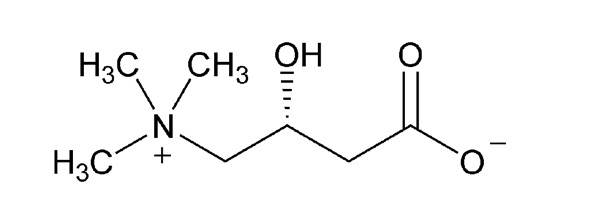
Empirical Formula: C 7 H 15 NO 3
Molecular Weight: 161.20 g/mol
Levocarnitine injection, USP is a clear, colorless sterile solution containing 1 g of levocarnitine, USP per 5 mL vial and water for injection. The pH is adjusted to 6.0 to 6.5 with hydrochloric acid or sodium hydroxide.
CLINICAL PHARMACOLOGY
Levocarnitine injection is a naturally occurring substance required in mammalian energy metabolism. It has been shown to facilitate long-chain fatty acid entry into cellular mitochondria, thereby delivering substrate for oxidation and subsequent energy production. Fatty acids are utilized as an energy substrate in all tissues except the brain. In skeletal and cardiac muscle, fatty acids are the main substrate for energy production.
Primary systemic carnitine deficiency is characterized by low concentrations of levocarnitine in plasma, RBC, and/or tissues. It has not been possible to determine which symptoms are due to carnitine deficiency and which are due to an underlying organic acidemia, as symptoms of both abnormalities may be expected to improve with levocarnitine injection. The literature reports that carnitine can promote the excretion of excess organic or fatty acids in patients with defects in fatty acid metabolism and/or specific organic acidopathies that bioaccumulate acylCoA esters. 1-6
Secondary carnitine deficiency can be a consequence of inborn errors of metabolism or iatrogenic factors such as hemodialysis. Levocarnitine injection may alleviate the metabolic abnormalities of patients with inborn errors that result in accumulation of toxic organic acids. Conditions for which this effect has been demonstrated are: glutaric aciduria II, methyl malonic aciduria, propionic acidemia, and medium chain fatty acylCoA dehydrogenase deficiency. 7,8 Autointoxication occurs in these patients due to the accumulation of acylCoA compounds that disrupt intermediary metabolism. The subsequent hydrolysis of the acylCoA compound to its free acid results in acidosis which can be life-threatening. Levocarnitine clears the acylCoA compound by formation of acylcarnitine, which is quickly excreted. Carnitine deficiency is defined biochemically as abnormally low plasma concentrations of free carnitine, less than 20 µmol/L at one week post term and may be associated with low tissue and/or urine concentrations. Further, this condition may be associated with a plasma concentration ratio of acylcarnitine/levocarnitine greater than 0.4 or abnormally elevated concentrations of acylcarnitine in the urine. In premature infants and newborns, secondary deficiency is defined as plasma levocarnitine concentrations below age-related normal concentrations.
End Stage Renal Disease (ESRD) patients on maintenance hemodialysis may have low plasma carnitine concentrations and an increased ratio of acylcarnitine/carnitine because of reduced intake of meat and dairy products, reduced renal synthesis and dialytic losses. Certain clinical conditions common in hemodialysis patients such as malaise, muscle weakness, cardiomyopathy and cardiac arrhythmias may be related to abnormal carnitine metabolism.
Pharmacokinetic and clinical studies with levocarnitine injection have shown that administration of levocarnitine to ESRD patients on hemodialysis results in increased plasma levocarnitine concentrations.
HOW SUPPLIED
Levocarnitine injection USP, 200 mg/mL is supplied as single-dose vial available in following strength and pack size:
Strength | Packaging Configuration | NDC Number |
1 gm/5 mL (200 mg/mL) | 10 x 5 mL single-dose vials per carton | 36000-368-10 |
Store at 20°C to 25°C (68°F to 77°F) [see USP Controlled Room Temperature]. Avoid excessive heat. Protect from freezing. Discard any unused portion of an opened vial, as the formulation does not contain a preservative.
Rx only.
REFERENCES
- Bohmer, T., Rydning, A. and Solberg, H.E. 1974. Carnitine levels in human serum in health and disease. Clin. Chim. Acta 57:55-61.
- Brooks, H., Goldberg, L., Holland, R. et al. 1977. Carnitine-induced effects on cardiac and peripheral hemodynamics. J. Clin. Pharmacol. 17:561-568.
- Christiansen, R., Bremer, J. 1976. Active transport of butyrobetaine and carnitine into isolated liver cells. Biochim. Biophys. Acta 448:562-577.
- Lindstedt, S. and Lindstedt, G. 1961. Distribution and excretion of carnitine in the rat. Acta Chem. Scand. 15:701-702.
- Rebouche, C.J. and Engel, A.G. 1983. Carnitine metabolism and deficiency syndromes. Mayo Clin. Proc. 58:533-540.
- Rebouche, C.J. and Paulson, D.J. 1986. Carnitine metabolism and function in humans. Ann. Rev. Nutr. 6:41-66.
- Scriver, C.R., Beaudet, A.L., Sly, W.S. and Valle, D. 1989. The Metabolic Basis of Inherited Disease. New York: McGraw-Hill.
- Schaub, J., Van Hoof, F. and Vis, H.L. 1991. Inborn Errors of Metabolism. New York: Raven Press.
- Marzo, A., Arrigoni Martelli, E., Mancinelli, A., Cardace, G., Corbelletta, C., Bassani, E. and Solbiati, M. 1991. Protein binding of L-carnitine family components. Eur. J. Drug Met. Pharmacokin. , Special Issue III: 364-368.
- Rebouche, C.J. 1991. Quantitative estimation of absorption and degradation of a carnitine supplement by human adults. Metabolism 40:1305-1310.
Manufactured by: Baxter Pharmaceuticals India Private Ltd Ahmedabad 382213, India
Manufactured for: Baxter Healthcare Corporation Deerfield, IL 60015 USA
Rev. 2026-02-27
1400008639
Baxter is a registered trademark of Baxter International Inc.
