Get your patient on Levocarnitine - Levocarnitine solution (Levocarnitine)
Levocarnitine - Levocarnitine solution prescribing information

INDICATIONS AND USAGE
Levocarnitine Oral Solution USP is indicated in the treatment of primary systemic carnitine deficiency. In the reported cases, the clinical presentation consisted of recurrent episodes of Reye-like encephalopathy, hypoketotic hypoglycemia, and/or cardiomyopathy. Associated symptoms included hypotonia, muscle weakness and failure to thrive. A diagnosis of primary carnitine deficiency requires that serum, red cell and/or tissue carnitine levels be low and that the patient does not have a primary defect in fatty acid or organic acid oxidation (see Clinical Pharmacology ). In some patients, particularly those presenting with cardiomyopathy, carnitine supplementation rapidly alleviated signs and symptoms. Treatment should include, in addition to carnitine, supportive and other therapy as indicated by the condition of the patient.
Levocarnitine Oral Solution USP is also indicated for acute and chronic treatment of patients with an inborn error of metabolism which results in a secondary carnitine deficiency.
CONTRAINDICATIONS
None known.
DOSAGE AND ADMINISTRATION
Levocarnitine Oral Solution USP.
For oral use only. Not for parenteral use.
Adults: The recommended dosage of levocarnitine is 1 to 3 g/day for a 50 kg subject, which is equivalent to 10 to 30 mL/day of Levocarnitine Oral Solution USP. Higher doses should be administered only with caution and only where clinical and biochemical considerations make it seem likely that higher doses will be of benefit. Dosage should start at 1 g/day, (10 mL/day), and be increased slowly while assessing tolerance and therapeutic response. Monitoring should include periodic blood chemistries, vital signs, plasma carnitine concentrations, and overall clinical condition.
Infants and children: The recommended dosage of levocarnitine is 50 to 100 mg/kg/day which is equivalent to 0.5 mL/kg/day Levocarnitine Oral Solution USP. Higher doses should be administered only with caution and only where clinical and biochemical considerations make it seem likely that higher doses will be of benefit. Dosage should start at 50 mg/kg/day, and be increased slowly to a maximum of 3 g/day (30 mL/day) while assessing tolerance and therapeutic response. Monitoring should include periodic blood chemistries, vital signs, plasma carnitine concentrations, and overall clinical condition.
Levocarnitine Oral Solution USP may be consumed alone or dissolved in drink or other liquid food. Doses should be spaced evenly throughout the day (every three or four hours) preferably during or following meals and should be consumed slowly in order to maximize tolerance.
CONTRAINDICATIONS
None known.
ADVERSE REACTIONS
The following adverse reactions associated with the use of oral formulations of levocarnitine were identified in clinical trials or postmarketing reports. Because these reactions were reported voluntarily from a population of uncertain size, it is not always possible to estimate their frequency, reliability, or to establish a causal relationship to drug exposure.
Gastrointestinal Reactions : Various mild gastrointestinal complaints have been reported during the long-term administration of oral L- or D,L-carnitine; these include transient nausea and vomiting, abdominal cramps, and diarrhea. Gastrointestinal adverse reactions with Levocarnitine Oral Solution USP dissolved in liquids might be avoided by a slow consumption of the solution or by a greater dilution. Decreasing the dosage often diminishes or eliminates drug-related patient body odor or gastrointestinal symptoms when present. Tolerance should be monitored very closely during the first week of administration, and after any dosage increases.
Musculoskeletal Reactions: Mild myasthenia has been described only in uremic patients receiving D,L-carnitine.
Neurologic Reactions: Seizures have been reported to occur in patients with or without pre-existing seizure activity receiving either oral or intravenous levocarnitine. In patients with pre-existing seizure activity, an increase in seizure frequency and/or severity has been reported.
Hypersensitivity Reactions : Rash, urticaria, and facial edema have been reported with Levocarnitine Oral Solution USP
(see WARNINGS ).
To report SUSPECTED ADVERSE REACTIONS, contact Rising Pharma Holdings, Inc. at 1-844-874-7464 or FDA at 1-800-FDA-1088 or www.FDA.gov/medwatch.
DESCRIPTION
Levocarnitine is a carrier molecule in the transport of long-chain fatty acids across the inner mitochondrial membrane. The chemical name of levocarnitine is 3-carboxy-2(R)-hydroxy-N,N,N-trimethyl-1-propanaminium, inner salt. Levocarnitine is a white crystalline, hygroscopic powder. It is readily soluble in water, hot alcohol, and insoluble in acetone. The specific rotation of levocarnitine is between -29° and -32°. Its chemical structure is:
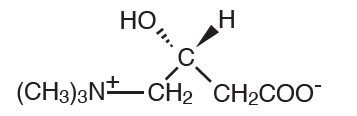
Molecular Formula: C 7 H 15 NO 3 Molecular Weight: 161.20
Each 118 mL container of Levocarnitine Oral Solution USP contains 1 g of levocarnitine/10 mL. Also contains: Artificial Cherry Flavor, D,L,-Malic Acid, Purified Water, Sucrose Syrup. Methylparaben NF and Propylparaben NF are added as preservatives. The pH is approximately 5.
CLINICAL PHARMACOLOGY
Levocarnitine is a naturally occurring substance required in mammalian energy metabolism. It has been shown to facilitate long-chain fatty acid entry into cellular mitochondria, thereby delivering substrate for oxidation and subsequent energy production. Fatty acids are utilized as an energy substrate in all tissues except the brain. In skeletal and cardiac muscle, fatty acids are the main substrate for energy production.
Primary systemic carnitine deficiency is characterized by low concentrations of levocarnitine in plasma, RBC, and/or tissues. It has not been possible to determine which symptoms are due to carnitine deficiency and which are due to an underlying organic acidemia, as symptoms of both abnormalities may be expected to improve with Levocarnitine Oral Solution USP. The literature reports that carnitine can promote the excretion of excess organic or fatty acids in patients with defects in fatty acid metabolism and/or specific organic acidopathies that bioaccumulate acylCoA esters. 1-6
Secondary carnitine deficiency can be a consequence of inborn errors of metabolism. Levocarnitine Oral Solution USP may alleviate the metabolic abnormalities of patients with inborn errors that result in accumulation of toxic organic acids. Conditions for which this effect has been demonstrated are: glutaric aciduria II, methyl malonic aciduria, propionic acidemia, and medium chain fatty acylCoA dehydrogenase deficiency. 7,8 Autointoxication occurs in these patients due to the accumulation of acylCoA compounds that disrupt intermediary metabolism. The subsequent hydrolysis of the acylCoA compound to its free acid results in acidosis which can be life-threatening. Levocarnitine clears the acylCoA compound by formation of acylcarnitine, which is quickly excreted. Carnitine deficiency is defined biochemically as abnormally low plasma concentrations of free carnitine, less than 20 μmol/L at one week post term and may be associated with low tissue and/or urine concentrations. Further, this condition may be associated with a plasma concentration ratio of acylcarnitine/levocarnitine greater than 0.4 or abnormally elevated concentrations of acylcarnitine in the urine. In premature infants and newborns, secondary deficiency is defined as plasma levocarnitine concentrations below age-related normal concentrations.
PHARMACOKINETICS
In a relative bioavailability study in 15 healthy adult male volunteers, levocarnitine tablets were found to be bio-equivalent to levocarnitine oral solution. Following 4 days of dosing with 6 tablets of levocarnitine 330 mg b.i.d. or 2 g of levocarnitine oral solution b.i.d., the maximum plasma concentration (Cmax) was about 80 µmol/L and the time to maximum plasma concentration (Tmax) occurred at 3.3 hours.
The plasma concentration profiles of levocarnitine after a slow 3 minute intravenous bolus dose of 20 mg/ kg of levocarnitine were described by a two-compartment model. Following a single i.v. administration, approximately 76% of the levocarnitine dose was excreted in the urine during the 0-24h interval. Using plasma concentrations uncorrected for endogenous levocarnitine, the mean distribution half life was 0.585 hours and the mean apparent terminal elimination half life was 17.4 hours.
The absolute bioavailability of levocarnitine from the two oral formulations of levocarnitine, calculated after correction for circulating endogenous plasma concentrations of levocarnitine, was 15.1 ± 5.3% for levocarnitine tablets and 15.9 ± 4.9% for levocarnitine oral solution USP.
Total body clearance of levocarnitine (Dose/AUC including endogenous baseline concentrations) was a mean of 4.00 L/h.
Levocarnitine was not bound to plasma protein or albumin when tested at any concentration or with any species including the human. 9
METABOLISM AND EXCRETION
In a pharmacokinetic study where five normal adult male volunteers received an oral dose of [ 3 H-methyl]-L-carnitine following 15 days of a high carnitine diet and additional carnitine supplement, 58 to 65% of the administered radioactive dose was recovered in the urine and feces in 5 to 11 days. Maximum concentration of [ 3 H-methyl]-L-carnitine in serum occurred from 2.0 to 4.5 hr after drug administration. Major metabolites found were trimethylamine N-oxide, primarily in urine (8% to 49% of the administered dose) and [ 3 H]-γ-butyrobetaine, primarily in feces (0.44% to 45% of the administered dose). Urinary excretion of levocarnitine was about 4 to 8% of the dose. Fecal excretion of total carnitine was less than 1% of the administered dose. 10
After attainment of steady state following 4 days of oral administration of Levocarnitine Oral Solution USP (2000 mg q12h) to 15 healthy male volunteers, the mean urinary excretion of levocarnitine during a single dosing interval (12h) was about 9% of the orally administered dose (uncorrected for endogenous urinary excretion).
HOW SUPPLIED
Levocarnitine Oral Solution USP is supplied in 118 mL (4 FL. OZ.) multiple-dose plastic containers. The multiple-dose containers are packaged 24 per case (NDC 64980-503-12). Store at 20° to 25°C (68° to 77°F); excursion permitted to 15° to 30°C (59° to 86°F) [See USP Controlled Room Temperature].
Rx only.
