Get your patient on Molindone Hydrochloride - Molindone Hydrochloride tablet (Molindone Hydrochloride)
Molindone Hydrochloride - Molindone Hydrochloride tablet prescribing information

WARNING
Increased Mortality in Elderly Patients with Dementia-Related Psychosis – Elderly patients with dementia-related psychosis treated with antipsychotic drugs are at an increased risk of death. Analyses of seventeen placebo-controlled trials (modal duration of 10 weeks), largely in patients taking atypical antipsychotic drugs, revealed a risk of death in drug-treated patients of between 1.6 to 1.7 times the risk of death in placebo-treated patients. Over the course of a typical 10-week controlled trial, the rate of death in drug-treated patients was about 4.5%, compared to a rate of about 2.6% in the placebo group. Although the causes of death were varied, most of the deaths appeared to be either cardiovascular (e.g., heart failure, sudden death) or infectious (e.g., pneumonia) in nature. Observational studies suggest that, similar to atypical antipsychotic drugs, treatment with conventional antipsychotic drugs may increase mortality. The extent to which the findings of increased mortality in observational studies may be attributed to the antipsychotic drug as opposed to some characteristic(s) of the patients is not clear. Molindone Hydrochloride Tablets, USP are not approved for the treatment of patients with dementia-related psychosis (see WARNINGS ).
INDICATIONS AND USAGE
Molindone Hydrochloride Tablets, USP are indicated for the management of schizophrenia. The efficacy of Molindone Hydrochloride Tablets, USP in schizophrenia was established in clinical studies which enrolled newly hospitalized and chronically hospitalized, acutely ill, schizophrenic patients as subjects.
DOSAGE AND ADMINISTRATION
Initial and maintenance doses of Molindone Hydrochloride Tablets should be individualized.
Initial Dosage Schedule
The usual starting dosage is 50 to 75 mg/day.
—Increase to 100 mg/day in 3 or 4 days.
- —Based on severity of symptomatology, dosage may be titrated up or down depending on individual patient response.
—An increase to 225 mg/day may be required in patients with severe symptomatology.
- Elderly and debilitated patients should be started on lower dosage.
Maintenance Dosage Schedule
- Mild-5 mg to 15 mg three or four times a day.
- Moderate-10 mg to 25 mg three or four times a day.
Severe-225 mg/day may be required.
CONTRAINDICATIONS
Molindone Hydrochloride Tablets are contraindicated in severe central nervous system depression (alcohol, barbiturates, narcotics, etc.) or comatose states, and in patients with known hypersensitivity to the drug.
ADVERSE REACTIONS
CNS Effects
The most frequently occurring effect is initial drowsiness that generally subsides with continued usage of the drug or lowering of the dose.
Noted less frequently were depression, hyperactivity and euphoria.
Neurological
Extrapyramidal Symptoms
Extrapyramidal symptoms noted below may occur in susceptible individuals and are usually reversible with appropriate management.
Akathisia
Motor restlessness may occur early.
Parkinson Syndrome
Akinesia, characterized by rigidity, immobility and reduction of voluntary movements and tremor, have been observed. Occurrence is less frequent than akathisia.
Dystonia
Class effect: Symptoms of dystonia, prolonged abnormal contractions of muscle groups, may occur in susceptible individuals during the first few days of treatment. Dystonic symptoms include: spasm of the neck muscles, sometimes progressing to tightness of the throat, swallowing difficulty, difficulty breathing, and/or protrusion of the tongue. While these symptoms can occur at low doses, they occur more frequently and with greater severity with high potency and at higher doses of first generation antipsychotic drugs. An elevated risk of acute dystonia is observed in males and younger age groups.
Tardive Dyskinesia
Antipsychotic drugs are known to cause a syndrome of dyskinetic movements commonly referred to as tardive dyskinesia. The movements may appear during treatment or upon withdrawal of treatment and may be either reversible or irreversible (i.e., persistent) upon cessation of further antipsychotic administration.
The syndrome is known to have a variable latency for development and the duration of the latency cannot be determined reliably. It is thus wise to assume that any antipsychotic agent has the capacity to induce the syndrome and act accordingly until sufficient data has been collected to settle the issue definitively for a specific drug product. In the case of antipsychotics known to produce the irreversible syndrome, the following has been observed.
Tardive dyskinesia has appeared in some patients on long-term therapy and has also appeared after drug therapy has been discontinued. The risk appears to be greater in elderly patients on high-dose therapy, especially females. The symptoms are persistent and in some patients appear to be irreversible. The syndrome is characterized by rhythmical involuntary movements of the tongue, face, mouth or jaw (e.g., protrusion of tongue, puffing of cheeks, puckering of mouth, chewing movements). There may be involuntary movements of extremities.
There is no known effective treatment of tardive dyskinesia; antiparkinsonism agents usually do not alleviate the symptoms of this syndrome. It is suggested that all antipsychotic agents be discontinued if these symptoms appear. Should it be necessary to reinstitute treatment, or increase the dosage of the agent, or switch to a different antipsychotic agent, the syndrome may be masked. It has been reported that fine vermicular movements of the tongue may be an early sign of the syndrome and if the medication is stopped at that time the syndrome may not develop (See WARNINGS ).
Autonomic Nervous System
Occasionally blurring of vision, tachycardia, nausea, dry mouth and salivation have been reported. Urinary retention and constipation may occur particularly if anticholinergic drugs are used to treat extrapyramidal symptoms. One patient being treated with Molindone Hydrochloride experienced priapism which required surgical intervention, apparently resulting in residual impairment of erectile function.
Laboratory Tests
There have been rare reports of leucopenia and leucocytosis. If such reactions occur, treatment with Molindone Hydrochloride may continue if clinical symptoms are absent. Alterations of blood glucose, B.U.N., and red blood cells have not been considered clinically significant.
Metabolic and Endocrine Effects
Alteration of thyroid function has not been significant. Amenorrhea has been reported infrequently. Resumption of menses in previously amenorrheic women has been reported. Initially heavy menses may occur. Galactorrhea and gynecomastia have been reported infrequently. Increase in libido has been noted in some patients. Impotence has not been reported. Although both weight gain and weight loss have been in the direction of normal or ideal weight, excessive weight gain has not occurred with Molindone Hydrochloride.
Hepatic Effects
There have been rare reports of clinically significant alterations in liver function in association with Molindone Hydrochloride use.
Cardiovascular
Rare, transient, non-specific T wave changes have been reported on E.K.G. Association with a clinical syndrome has not been established. Rarely has significant hypotension been reported.
Ophthalmological
Lens opacities and pigmentary retinopathy have not been reported where patients have received Molindone Hydrochloride. In some patients, phenothiazine induced lenticular opacities have resolved following discontinuation of the phenothiazine while continuing therapy with Molindone Hydrochloride.
Skin
Early, non-specific skin rash, probably of allergic origin, has occasionally been reported. Skin pigmentation has not been seen with Molindone Hydrochloride usage alone.
Molindone Hydrochloride has certain pharmacological similarities to other antipsychotic agents. Because adverse reactions are often extensions of the pharmacological activity of a drug, all of the known pharmacological effects associated with other antipsychotic drugs should be kept in mind when Molindone Hydrochloride is used. Upon abrupt withdrawal after prolonged high dosage an abstinence syndrome has not been noted.
Drug Interactions
Potentiation of drugs administered concurrently with Molindone Hydrochloride has not been reported. Additionally, animal studies have not shown increased toxicity when Molindone Hydrochloride is given concurrently with representative members of three classes of drugs (i.e., barbiturates, chloral hydrate and antiparkinson drugs).
DESCRIPTION
Molindone Hydrochloride is a dihydroindolone compound which is not structurally related to the phenothiazines, the butyrophenones or the thioxanthenes.
Molindone Hydrochloride is 3-ethyl-6, 7-dihydro-2-methyl-5-(morpholinomethyl) indol-4(5H)-one hydrochloride. It is a white to off-white or pale-pink crystalline powder, freely soluble in water and alcohol.
Molindone Hydrochloride Tablets, USP contain the following inactive ingredients: alginic acid, calcium sulfate, colloidal silicon dioxide, lactose monohydrate, magnesium stearate, microcrystalline cellulose, povidone and sodium starch glycolate.
Colors: 5 mg contains FD&C Yellow #6 Aluminum Lake
- 10 mg contains FD&C Blue #2 Aluminum Lake
- 25 mg contains FD&C Blue #2 Aluminum Lake, FD&C Yellow #6, Aluminum Lake and D&C Yellow #10 Aluminum Lake
Molindone Hydrochloride is represented by the following structural formula:
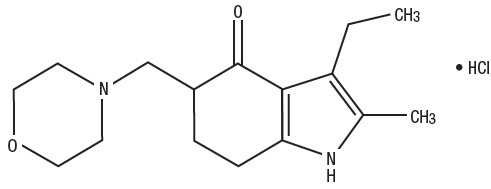
The empirical formula is C 16 H 24 N 2 O 2 •HCl representing a molecular weight of 312.83.
CLINICAL PHARMACOLOGY
Molindone Hydrochloride has a pharmacological profile in laboratory animals which predominantly resembles that of other antipsychotic agents causing reduction of spontaneous locomotion and aggressiveness, suppression of a conditioned response and antagonism of the bizarre stereotyped behavior and hyperactivity induced by amphetamines. In addition, Molindone Hydrochloride antagonizes the depression caused by the tranquilizing agent tetrabenazine.
In human clinical studies an antipsychotic effect is achieved in the absence of muscle relaxing or incoordinating effects. Based on EEG studies, Molindone Hydrochloride exerts its effect on the ascending reticular activating system.
Human metabolic studies show Molindone Hydrochloride Tablets to be rapidly absorbed and metabolized when given orally. Unmetabolized drug reached a peak blood level at 1.5 hours. Pharmacological effect from a single oral dose persists for 24 to 36 hours. There are 36 recognized metabolites with less than 2 to 3% unmetabolized Molindone Hydrochloride Tablets being excreted in urine and feces.
HOW SUPPLIED
Molindone Hydrochloride Tablets USP, 5 mg are light orange to orange, oval-shaped tablets, debossed " Є336 " on one side and plain on the other side. They are supplied as follows:
Bottles of 100 NDC 42806-336-01
Molindone Hydrochloride Tablets USP, 10 mg are light blue to blue, oval-shaped tablets, debossed " Є337 " on one side and plain on the other side. They are supplied as follows:
Bottles of 100 NDC 42806-337-01
Molindone Hydrochloride Tablets USP, 25 mg are light green to green, oval-shaped tablet, debossed " Є338 " on one side and bisect on the other side. They are supplied as follows:
Bottles of 100 NDC 42806-338-01
Store at 20° to 25°C (68° to 77°F) [See USP Controlled Room Temperature].
Dispense in a tight, light-resistant container as defined in the USP, with a child-resistant closure (as required).
KEEP TIGHTLY CLOSED
• Benadryl is a registered trademark of Warner-Lambert.
† Symmetrel is a registered trademark of Endo Pharmaceuticals Inc.
‡ Artane is a registered trademark of Lederle Laboratories.
§ Cogentin is a registered trademark of Merck & Co., Inc.
¶ Akineton is a registered trademark of Knoll Laboratories.
Distributed by:
Epic Pharma, LLC
Laurelton NY, 11413
Rev. 11-2024-00
MF336REV11/24
OE2798
