Get your patient on Motofen (Difenoxin And Atropine Sulfate)
Motofen prescribing information

INDICATIONS AND USAGE
MOTOFEN ® is indicated as adjunctive therapy in the management of acute nonspecific diarrhea and acute exacerbations of chronic functional diarrhea.
DOSAGE AND ADMINISTRATION
The recommended starting dose of MOTOFEN ® tablets in adults is 2 tablets then 1 tablet after each loose stool or 1 tablet every 3 to 4 hours as needed, but the total dosage during any 24-hour treatment period should not exceed 8 tablets. In the treatment of diarrhea, if clinical improvement is not observed in 48 hours, continued administration of this type of medication is not recommended. For acute diarrheas and acute exacerbations of functional diarrhea, treatment beyond 48 hours is usually not necessary.
Studies in children below the age of 12 have been inadequate to evaluate the safety and effectiveness of MOTOFEN ® in this age group. MOTOFEN ® is contraindicated in children under 2 years of age.
CONTRAINDICATIONS
MOTOFEN ® is contraindicated in patients with diarrhea associated with organisms that penetrate the intestinal mucosa (toxigenic E. coli, Salmonella species, Shigella ) and pseudomembranous colitis associated with broad spectrum antibiotics. Antiperistaltic agents should not be used in the conditions because they may prolong and/or worsen diarrhea.
MOTOFEN ® is contraindicated in children under 2 years of age because of the decreased margin of safety of drugs in this class in younger age groups.
MOTOFEN ® is contraindicated in patients with a known hypersensitivity to difenoxin, atropine, or any of the inactive ingredients, and in patients who are jaundiced.
ADVERSE REACTIONS
In view of the small amount of atropine present (0.025 mg/tablet), such effects such as dryness of the skin and mucous membranes, flushing, hyperthermia, tachycardia and urinary retention are very unlikely to occur, except perhaps in children.
Many of the adverse effects reported during clinical investigation of MOTOFEN ® are difficult to distinguish from symptoms associated with the diarrheal syndrome. However, the following events were reported at the stated frequencies:
Gastrointestinal: Nausea, 1 in 15 patients; vomiting, 1 in 30 patients; dry mouth, 1 in 30 patients; epigastric distress, 1 in 100 patients; and constipation, 1 in 300 patients.
Central Nervous System: Dizziness and light-headedness, 1 in 20 patients; drowsiness, 1 in 25 patients; and headache, 1 in 40 patients; tiredness, nervousness, insomnia and confusion ranged from 1 in 200 to 1 in 600 patients.
Other less frequent reactions: Burning eyes and blurred vision occurred in a few cases.
The following adverse reactions have been reported in patients receiving chemically-related drugs: numbness of extremities, euphoria, depression, sedation, anaphylaxis, angioneurotic edema, urticaria, swelling of the gums, pruritus, toxic megacolon, paralytic ileus, pancreatitis, and anorexia.
THIS MEDICATION SHOULD BE KEPT IN A CHILD-RESISTANT CONTAINER AND OUT OF THE REACH OF CHILDREN SINCE AN OVERDOSAGE MAY RESULT IN SEVERE RESPIRATORY DEPRESSION AND COMA, POSSIBLY LEADING TO PERMANENT BRAIN DAMAGE OR DEATH.
Drug Interactions
Since the chemical structure of difenoxin hydrochloride is similar to meperidine hydrochloride, the concurrent use of MOTOFEN ® with monoamine oxidase inhibitors may, in theory, precipitate a hypertensive crisis.
MOTOFEN ® may potentiate the action of barbiturates, tranquilizers, narcotics, and alcohol. When these medications are used concomitantly with MOTOFEN ® , the patient should be closely monitored.
Diphenoxylate hydrochloride, from which the principal active metabolite difenoxin is derived, was found to inhibit the hepatic microsomal enzyme system at a dose of 2 mg/kg/day in studies conducted with male rats. Therefore, difenoxin has the potential to prolong the biological half-lives of drugs for which the rate of elimination is dependent on the microsomal drug metabolizing enzyme system.
DESCRIPTION
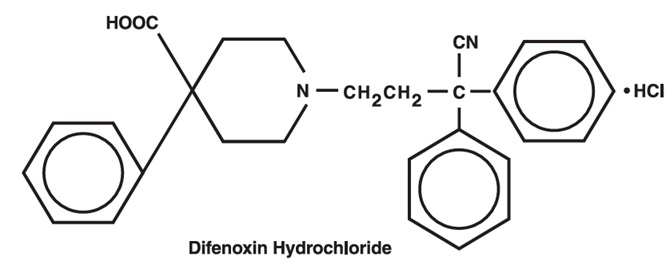
Each five-sided dye free MOTOFEN ® tablet contains: 1 mg of difenoxin (equivalent to 1.09 mg of difenoxin hydrochloride) and 0.025 mg of atropine sulfate (equivalent to 0.01 mg of atropine). Difenoxin hydrochloride, 1-(3-cyano-3,3-diphenylpropyl)-4-phenyl-4-piperidinecarboxylic acid monohydrochloride, is an orally administered antidiarrheal agent which is chemically related to the narcotic meperidine.
The structural formula is:
Atropine sulfate is present to discourage deliberate overdose.
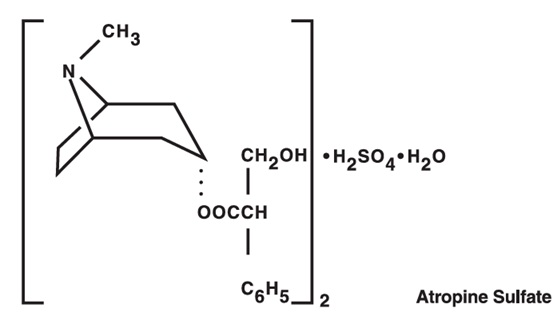
Atropine sulfate, an anticholinergic, is benzeneacetic acid, α-(hydroxymethyl)-, 8-methyl-8-azabicyclo[3.2.1]oct-3-yl ester, endo-(±)-, (2:1) (salt), monohydrate and has the following structural formula:
Inactive Ingredients: calcium stearate, cellulose, lactose, corn starch.
CLINICAL PHARMACOLOGY
Animal studies have shown that difenoxin hydrochloride manifests its antidiarrheal effect by slowing intestinal motility. The mechanism of action is by a local effect on the gastrointestinal wall.
Difenoxin is the principal active metabolite of diphenoxylate.
Following oral administration of MOTOFEN ® , difenoxin is rapidly and extensively absorbed. Mean peak plasma levels of approximately 160 ng/mL occurred within 40 to 60 minutes in most patients following an oral dose of 2 mg. Plasma levels decline to less than 10% of their peak values within 24 hours and to less than 1% of their peak values within 72 hours. This decline parallels the appearance of difenoxin and its metabolites in the urine. Difenoxin is metabolized to an inactive hydroxylated metabolite. Both the drug and its metabolites are excreted, mainly as conjugates, in urine and feces.
HOW SUPPLIED
MOTOFEN ® is available as a white, dye-free, five-sided, scored tablet with “0200” on the scored side and "M" on the other side. Each tablet contains 1 mg difenoxin and 0.025 mg atropine sulfate. Supplied in bottles of 100 tablets (NDC 83107-011-10). Store at 20°-25°C (68°-77°F) [See USP Controlled Room Temperature].
