Get your patient on Nicotrol - Nicotine spray, Metered (Nicotine)
Nicotrol - Nicotine spray, Metered prescribing information

INDICATIONS AND USAGE
NICOTROL NS is indicated as an aid to smoking cessation for the relief of nicotine withdrawal symptoms. NICOTROL NS therapy should be used as a part of a comprehensive behavioral smoking cessation program.
The safety and efficacy of the continued use of NICOTROL NS for periods longer than 6 months have not been adequately studied and such use is not recommended.
DOSAGE AND ADMINISTRATION
It is important that patients understand the instructions for use of NICOTROL NS, and have their questions answered. They should clearly understand the directions for using NICOTROL NS and safely disposing of the used container. They should be instructed to stop smoking completely when they begin using the product.
Patients should be instructed not to sniff, swallow or inhale through the nose as the spray is being administered. They should also be advised to administer the spray with the head tilted back slightly.
The dose of NICOTROL NS, should be individualized on the basis of each patient's nicotine dependence and the occurrence of symptoms of nicotine excess (See Individualization of Dosage ).
Each actuation of NICOTROL NS delivers a metered 50 microliter spray containing 0.5 mg of nicotine. One dose is 1 mg of nicotine (2 sprays, one in each nostril).
Patients should be started with 1 or 2 doses per hour, which may be increased up to a maximum recommended dose of 40 mg (80 sprays, somewhat less than 1/2 bottle) per day. For best results, patients should be encouraged to use at least the recommended minimum of 8 doses per day, as less is unlikely to be effective. In clinical trials, the patients who successfully quit smoking used the product heavily when nicotine withdrawal was at its peak, sometimes up to the recommended maximum of 40 doses per day ( in heavier smokers). Dosing recommendations are summarized in Table 4.
| Maximum Recommended Duration of Treatment | Recommended Doses per Hour | Maximum Doses per Hour | Maximum Doses per Day |
|---|---|---|---|
3 months | 1–2 One dose=2 sprays (one in each nostril). One dose delivers 1 mg of nicotine to the nasal mucosa. | 5 | 40 |
No tapering strategy has been shown to be optimal in clinical studies. Many patients simply stopped using the spray at their last clinic visit.
Recommended strategies for discontinuation of use include suggesting that patients: use only 1/2 a dose (1 spray) at a time, use the spray less frequently, keep a tally of daily usage, try to meet a steadily reducing usage target, skip a dose by not medicating every hour, or set a planned "quit date" for stopping use of the spray.
Individualization of Dosage
The success or failure of smoking cessation is influenced by the quality, intensity and frequency of supportive care. Patients are more likely to quit smoking if they are seen frequently and participate in formal smoking cessation programs.
The goal of NICOTROL NS therapy is complete abstinence. If a patient is unable to stop smoking by the fourth week of therapy, treatment should probably be discontinued.
Patients who fail to quit on any attempt may benefit from interventions to improve their chances for success on subsequent attempts. Patients who were unsuccessful should be counseled and should then probably be given a "therapy holiday" before the next attempt. A new quit attempt should be encouraged when conditions are more favorable.
Based on the clinical trials, a reasonable approach to assisting patients in their attempt to quit smoking is to begin initial treatment, using the recommended dosage (See DOSAGE AND ADMINISTRATION ). Regular use of the spray during the first week of treatment may help patients adapt to the irritant effects of the spray. Dosage can then be adjusted in those subjects with signs or symptoms of nicotine withdrawal or excess. Patients who are successfully abstinent on NICOTROL NS should be treated at the selected dosage for up to 8 weeks, following which use of the spray should be discontinued over the next 4 to 6 weeks. Some patients may not require gradual reduction of dosage and may abruptly stop treatment successfully. Treatment with NICOTROL NS for longer periods has not been shown to improve outcome, and the safety of use for periods longer than 6 months has not been established.
The symptoms of nicotine withdrawal overlap those of nicotine excess (See CLINICAL PHARMACOLOGY, Pharmacodynamics and ADVERSE REACTIONS ). Since patients using NICOTROL NS may also smoke intermittently, it is sometimes difficult to determine if patients are experiencing nicotine withdrawal or nicotine excess. Controlled clinical trials of nicotine products suggest that palpitations, nausea and sweating are more often symptoms of nicotine excess, whereas anxiety, nervousness and irritability are more often symptoms of nicotine withdrawal.
CONTRAINDICATIONS
Use of NICOTROL NS therapy is contraindicated in patients with known hypersensitivity or allergy to nicotine or to any component of the product.
ADVERSE REACTIONS
Assessment of adverse events in the 730 patients who participated in controlled clinical trials is complicated by the occurrence of signs and symptoms of nicotine withdrawal in some patients and nicotine excess in others. The incidence of adverse events is confounded by the many minor complaints that smokers commonly have, by continued smoking by many patients and the local irritation from both active drug and the pepper placebo. No serious adverse events were reported during the trials.
Common Smoker's Complaints
Common complaints experienced by the smokers in the study (users of both active and placebo spray) include: chest tightness, dyspepsia, paresthesia (tingling) in limbs, constipation, and stomatitis.
Tobacco Withdrawal Symptoms
Symptoms of tobacco withdrawal were frequent in users of both active and placebo sprays. Common withdrawal symptoms seen in over 5% of patients included: anxiety, irritability, restlessness, cravings, dizziness, impaired concentration, weight increase, emotional lability, somnolence and fatigue, increased sweating, and insomnia. Less frequently seen probable withdrawal symptoms (under 5%) included: confusion, depression, apathy, tremor, increased appetite, incoordination, and increased dreaming.
Anxiety, irritability, restlessness, and tobacco cravings occurred about equally in both groups, while other symptoms tended to be slightly more common on placebo spray.
Effects of the Spray
NICOTROL NS and the pepper-containing placebo were both associated with irritant side effects on the nasopharyngeal and ocular tissues. During the first 2 days of treatment, nasal irritation was reported by nearly all (94%) of the patients, the majority of whom rated it as either moderate or severe. Both the frequency and severity of nasal irritation declined with continued use of NICOTROL NS but was still experienced by most (81%) of the patients after 3 weeks of treatment, with most patients rating it as moderate or mild.
Other common side effects for both active and placebo groups were: runny nose, throat irritation, watering eyes, sneezing, and coughing.
The following local events were reported somewhat more commonly for active than for placebo spray: nasal congestion, subjective comments related to the taste or use of the dosage form, sinus irritation, transient epistaxis, eye irritation, transient changes in sense of smell, pharyngitis, paresthesia of the nose, mouth or head, numbness of the nose, or mouth, burning of the nose or eyes, earache, facial flushing, transient changes in sense of taste, hoarseness, nasal ulcer or blister.
Effects of Nicotine
Feelings of dependence on the spray were reported by more patients on active spray than placebo. Drug-like effects such as calming were also more frequent on active spray (See DRUG ABUSE AND DEPENDENCE ).
Other Adverse Effects
Adverse events which could not be classified and listed above and which were reported by >1% of patients on active spray are listed in the following table:
Adverse Events Not Attributable to Intercurrent Illness
| Adverse Event | Active | Placebo |
|---|---|---|
HEADACHE | 18% | 15% |
BACK PAIN | 6% | 4% |
DYSPNEA | 5% | 6% |
NAUSEA | 5% | 5% |
ARTHRALGIA | 5% | 1% |
MENSTRUAL DISORDER | 4% | 4% |
PALPITATION | 4% | 4% |
FLATULENCE | 4% | 3% |
TOOTH DISORDER | 4% | 1% |
GUM PROBLEMS | 4% | 1% |
MYALGIA | 3% | 4% |
ABDOMINAL PAIN | 3% | 3% |
CONFUSION | 3% | 3% |
ACNE | 3% | 1% |
DYSMENORRHEA | 3% | 0% |
PRURITUS | 2% | 3% |
Adverse events reported with a frequency of <1% among active spray users are listed below:
Body as a Whole: edema peripheral, pain, numbness, allergy Gastrointestinal: dry mouth, hiccup, diarrhea Hematologic: purpura Neurological: aphasia, amnesia, migraine, numbness Respiratory: bronchitis, bronchospasm, sputum increased Skin and appendages: rash, purpura Special Senses: vision abnormal
Adverse reactions not listed above that have been identified during post-marketing experience with the nicotine nasal spray formulation are listed below:
Gastrointestinal disorders: dysphagia
General disorders and administration site conditions: chest pain
Immune system disorders: anaphylactic reaction
Nervous system disorders: seizure
Drug Interactions
The extent of absorption and peak plasma concentration is slightly reduced in patients with the common cold/rhinitis. In addition, the time to peak concentration is prolonged. The use of a nasal vasoconstrictor such as xylometazoline in patients with rhinitis will further prolong the time to peak (See PHARMACOKINETICS ). Smoking cessation, with or without nicotine replacement, may alter the pharmacokinetics of certain concomitant medications.
| May Require a Decrease in Dose at Cessation of Smoking | Possible Mechanism |
|---|---|
Acetaminophen, caffeine, imipramine, oxazepam, pentazocine, propranolol, or other beta-blockers, theophylline | Deinduction of hepatic enzymes on smoking cessation. |
Insulin | Increase of subcutaneous insulin absorption with smoking cessation. |
Adrenergic antagonists (e.g. prazosin, labetalol) | Decrease in circulating catecholamines with smoking cessation. |
May Require an Increase in Dose at Cessation of Smoking | Possible Mechanism |
Adrenergic agonists (e.g. isoproterenol, phenylephrine) | Decrease in circulating catecholamines with smoking cessation. |
DESCRIPTION
NICOTROL ® NS (nicotine nasal spray) is an aqueous solution of nicotine intended for administration as a metered spray to the nasal mucosa.
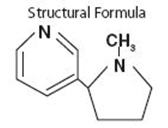
Nicotine is a tertiary amine composed of pyridine and a pyrrolidine ring. It is a colorless to pale yellow, freely water-soluble, strongly alkaline, oily, volatile, hygroscopic liquid obtained from the tobacco plant. Nicotine has a characteristic pungent odor and turns brown on exposure to air or light. Of its two stereoisomers, S(-)nicotine is the more active. It is the prevalent form in tobacco and is the form in NICOTROL NS. The free alkaloid is absorbed rapidly through skin, mucous membranes, and the respiratory tract.
Chemical Name: S-3-(1-methyl-2-pyrrolidinyl) pyridine
Molecular Formula: C 10 H 14 N 2
Molecular Weight: 162.23
Ionization Constants: pKa 1 = 7.84, pKa 2 = 3.04 at 15°C
Octanol-Water Partition Coefficient: 15:1 at pH 7
Each 10 mL spray bottle contains 100 mg nicotine (10 mg/mL) in an inactive vehicle containing disodium phosphate, sodium dihydrogen phosphate, citric acid, methylparaben, propylparaben, edetate disodium, sodium chloride, polysorbate 80, aroma and water. The solution is isotonic with a pH of 7. It contains no chlorofluorocarbons.
After priming the delivery system for NICOTROL NS, each actuation of the unit delivers a metered dose spray containing approximately 0.5 mg of nicotine. The size of the droplets produced by the unit is in excess of 8 microns. One NICOTROL NS unit delivers approximately 200 applications.
CLINICAL PHARMACOLOGY
Pharmacologic Action
Nicotine, the chief alkaloid in tobacco products, binds stereo-selectively to nicotinic-cholinergic receptors at the autonomic ganglia, in the adrenal medulla, at neuromuscular junctions, and in the brain. Two types of central nervous system effects are believed to be the basis of nicotine's positively reinforcing properties. A stimulating effect is exerted mainly in the cortex via the locus ceruleus and a reward effect is exerted in the limbic system. At low doses, the stimulant effects predominate while at high doses the reward effects predominate. Intermittent intravenous administration of nicotine activates neurohormonal pathways, releasing acetylcholine, norepinephrine, dopamine, serotonin, vasopressin, beta-endorphin, growth hormone, and ACTH.
Pharmacodynamics
The cardiovascular effects of nicotine include peripheral vasoconstriction, tachycardia, and elevated blood pressure. Acute and chronic tolerance to nicotine develops from smoking tobacco or ingesting nicotine preparations. Acute tolerance (a reduction in response for a given dose) develops rapidly (less than 1 hour), but not at the same rate for different physiologic effects (skin temperature, heart rate, subjective effects). Withdrawal symptoms such as cigarette craving can be reduced in most individuals by plasma nicotine levels lower than those from smoking.
Withdrawal from nicotine in addicted individuals can be characterized by craving, nervousness, restlessness, irritability, mood lability, anxiety, drowsiness, sleep disturbances, impaired concentration, increased appetite, minor somatic complaints (headache, myalgia, constipation, fatigue), and weight gain. Nicotine toxicity is characterized by nausea, abdominal pain, vomiting, diarrhea, diaphoresis, flushing, dizziness, disturbed hearing and vision, confusion, weakness, palpitations, altered respiration and hypotension.
Both smoking and nicotine can increase circulating cortisol and catecholamines, and tolerance does not develop to the catecholamine-releasing effects of nicotine. Changes in the response to a concomitantly administered adrenergic agonist or antagonist should be watched for when nicotine intake is altered during NICOTROL NS therapy and/or smoking cessation (See PRECAUTIONS, Drug Interactions ).
Pharmacokinetics
Each actuation of NICOTROL NS delivers a metered 50 microliter spray containing approximately 0.5 mg of nicotine. One dose is considered 1 mg of nicotine (2 sprays, one in each nostril).
Absorption
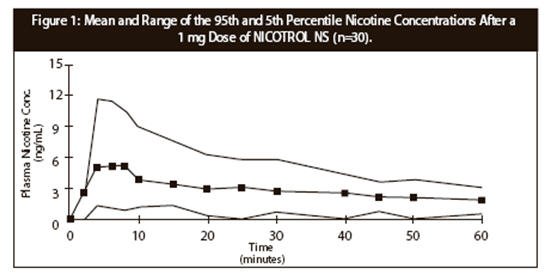
Following administration of 2 sprays of NICOTROL NS approximately 53% ± 16% (Mean ± SD) enters the systemic circulation. No significant difference in rate or extent of absorption could be seen due to the deposition of nicotine on different parts of the nasal mucosa. Plasma concentrations of nicotine obtained from 1 dose (1 mg nicotine) of NICOTROL NS rise rapidly, reaching maximum venous concentrations of 2–12 ng/mL in 4–15 minutes. The apparent absorption half-life of nicotine is approximately 3 minutes. There is wide variation among subjects in their plasma nicotine concentrations from the spray. As a result, after a 1 mg dose of spray approximately 20% of the subjects reached peak nicotine concentrations similar to those seen after smoking one cigarette (7–17 ng/mL) (See DRUG ABUSE AND DEPENDENCE ). Figure 1 below plots the mean and 5th and 95th percentile nicotine concentrations after a 1 mg single dose of the nasal spray (n=30).
| Dose | Mean (ng/mL) ± SD | (Range) |
|---|---|---|
1 mg every 60 minutes (1 mg/hr) | 6 ± 3 | (1.7–12) |
1 mg every 30 minutes (2 mg/hr) | 14 ± 6 | (1.5–24) |
1 mg every 20 minutes (3 mg/hr) | 18 ± 10 | (1.2–35) |
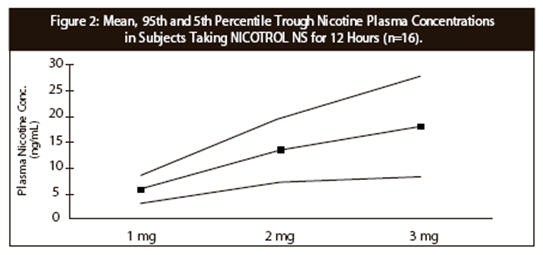
The data from Table 1 is derived from a three-way cross-over study of repeated applications of NICOTROL NS in sixteen smokers (8 male, 8 female) ranging in age from 18 to 48 years. There is a slight deviation from dose-concentration proportionality from one dose to three doses of NICOTROL NS per hour as shown in Figure 2.
Sixteen smokers (7 males and 9 females) ranging in age from 22 to 44 years were dosed with 1 mg of NICOTROL NS every hour for 10 hours. The pharmacokinetic parameters that were obtained are presented in Table 2.
| Parameter | 1 mg (2 sprays) | (Range) |
|---|---|---|
| C avg : average plasma nicotine concentration for the dosing interval of 10–11 hours | ||
| C max : maximum measured plasma concentration after last dose administration | ||
| T max : time of maximum plasma concentration after last dose administration | ||
C avg (ng/mL) | 8 ± 3 | (2.5–12) |
C max (ng/mL) | 9 ± 3 | (3.1–14) |
T max (minutes) | 13 ± 5 | (10–20) |
Distribution
The volume of distribution following IV administration of nicotine is approximately 2 to 3 L/kg. Plasma protein binding of nicotine is <5%. Therefore, changes in nicotine binding from use of concomitant drugs or alterations of plasma proteins by disease states would not be expected to have significant effects on nicotine kinetics.
Metabolism
More than 20 metabolites of nicotine have been identified, all of which are less active than the parent compound. The primary urinary metabolites are cotinine (15% of the dose) and trans-3-hydroxycotinine (45% of the dose). Cotinine has a half-life of 15 to 20 hours and concentrations that exceed nicotine by 10-fold. The major site for the metabolism of nicotine is the liver. The kidney and lung are also sites of nicotine metabolism.
Elimination
About 10% of the nicotine absorbed is excreted unchanged in the urine. This may be increased to up to 30% with high urine flow rates and urinary acidification below pH 5. The average plasma clearance is about 1.2 L/min in a healthy adult smoker. The apparent elimination half-life of nicotine from NICOTROL NS is 1 to 2 hours.
Pharmacokinetic Model
The data were well described by a two-compartment model with first-order input.
Based on individual fits (N=18) the following parameters were derived after the administration of a 1 mg dose: Absorption rate constant (Ka) = 14.4 ± 7.3 hr -1 (Mean ± SD), Elimination rate constant (Ke) = 0.60 ± 0.53 hr -1 , Distribution rate constants (K 12 ) = 4.84 ± 2.57 hr -1 , (K 21 ) = 4.35 ± 2.30 hr -1 , Volume of distribution over fraction absorbed (V/F) = 2.73 ± 0.82 L/kg in 8 female and 10 male adults weighing 76 ± 15 kg.
Gender Differences
Intersubject variability (50% coefficient of variation) among the pharmacokinetic parameters (AUC, C max and Clearance/kg) were observed for both genders. There were no differences between females or males in the kinetics of NICOTROL NS.
Renal Impairment
Progressive severity of renal impairment is associated with decreased total clearance of nicotine. Nicotine clearance was decreased by 30% on average in subjects with moderate renal impairment and 50% on average in subjects with severe renal impairment.
Hepatic Impairment
In smokers with liver cirrhosis but only mild impairment of hepatic function (Child-Pugh score 5), the pharmacokinetics of nicotine is unaffected. However, in smokers with moderately impaired liver function (Child-Pugh score 7), total clearance has been reported to be reduced on average by 40-50%. There are no data about the pharmacokinetics of nicotine in smokers with a Child-Pugh score exceeding 7, but these subjects are expected to show similar or greater effects on clearance of nicotine as patients with moderately impaired liver function.
Drug/Drug Interactions
The extent of absorption is slightly reduced (approximately 10%) in patients with the common cold/rhinitis. In patients with rhinitis the peak plasma concentration is reduced by approximately 20% (concentrations are lower by 1.5 ng/mL on average) and the time to peak concentration prolonged by approximately 30% (delayed by 7 minutes on average). The use of a nasal vasoconstrictor such as xylometazoline in patients with rhinitis will further prolong the time to peak by approximately 40% (delayed by 15 minutes on average), but the peak plasma concentration remains on average the same as those with rhinitis.
CLINICAL TRIALS
The efficacy of NICOTROL NS therapy as an aid to smoking cessation was demonstrated in three single-center, placebo-controlled, double-blind trials with a total of 730 patients. One of the trials used NICOTROL NS with individual counseling while the other two used group support. Patients with severe or symptomatic cardiovascular disease, hypertension, asthma, diabetes or severe allergy were not included in the studies. The amount of NICOTROL NS used was left to the discretion of each patient, with a minimum dose of 8 mg/day and a maximum dose of 40 mg/day.
In all three studies, the recommended duration of treatment was 3 months; however in two of these trials, 241 patients were permitted to continue to use the product for up to 1 year, if they wished. Among the 64 patients abstinent from cigarettes at the end of a year, 23 (36%) were still using the spray, and probable dependence on the spray was seen in several patients (See DRUG ABUSE AND DEPENDENCE ).
Quitting was defined as total abstinence from smoking for at least 4 weeks. The "quit rates" are the percentage of all persons initially enrolled who continuously abstained after week 2 or 4.
In all three studies, NICOTROL NS was more effective than placebo at 6 weeks, 3 months, 6 months, and 1 year. The two studies where NICOTROL NS could be used for more than 6 months did not have a better outcome at 1 year than the study in which NICOTROL NS was discontinued at 6 months.
| Group | Size (n) | At 6 Weeks | At 3 Months | At 6 Months | At 1 Year |
|---|---|---|---|---|---|
NICOTROL NS | 369 | 49–58% | 41–45% | 31–35% | 23–27% |
Placebo | 361 | 21–32% | 17–20% | 12–15% | 10–15% |
Patients treated with NICOTROL NS had more relief of the urge to smoke and withdrawal symptoms compared with placebo-treated patients.
NICOTROL NS allows the patient to vary the dose of nicotine on a short-term basis. As with other variable dose smoking cessation products, NICOTROL NS may be useful in the management of highly dependent smokers.
How Supplied
NICOTROL ® NS (nicotine nasal spray) 10 mg/mL, is supplied as four 10 mL bottles (NDC 0009-5401-01). Each unit consists of a glass container, mounted with a metered spray pump. A patient information leaflet is enclosed with the package.
Store at 25°C (77°F); excursions permitted to 15° to 30°C (59° to 86°F) [see USP Controlled Room Temperature].
Pharmacologic Action
Nicotine, the chief alkaloid in tobacco products, binds stereo-selectively to nicotinic-cholinergic receptors at the autonomic ganglia, in the adrenal medulla, at neuromuscular junctions, and in the brain. Two types of central nervous system effects are believed to be the basis of nicotine's positively reinforcing properties. A stimulating effect is exerted mainly in the cortex via the locus ceruleus and a reward effect is exerted in the limbic system. At low doses, the stimulant effects predominate while at high doses the reward effects predominate. Intermittent intravenous administration of nicotine activates neurohormonal pathways, releasing acetylcholine, norepinephrine, dopamine, serotonin, vasopressin, beta-endorphin, growth hormone, and ACTH.
