Get your patient on Norethindrone Acetate - Norethindrone Acetate tablet (Norethindrone Acetate)
Norethindrone Acetate - Norethindrone Acetate tablet prescribing information

INDICATIONS AND USAGE
Norethindrone acetate is indicated for the treatment of secondary amenorrhea, endometriosis, and abnormal uterine bleeding due to hormonal imbalance in the absence of organic pathology, such as submucous fibroids or uterine cancer. Norethindrone acetate is not intended, recommended or approved to be used with concomitant estrogen therapy in postmenopausal women for endometrial protection.
DOSAGE AND ADMINISTRATION
Therapy with norethindrone acetate must be adapted to the specific indications and therapeutic response of the individual patient.
Secondary amenorrhea, abnormal uterine bleeding due to hormonal imbalance in the absence of organic pathology:
2.5 to 10 mg norethindrone acetate may be given daily for 5 to 10 days to produce secretory transformation of an endometrium that has been adequately primed with either endogenous or exogenous estrogen.
Progestin withdrawal bleeding usually occurs within three to seven days after discontinuing norethindrone acetate therapy. Patients with a past history of recurrent episodes of abnormal uterine bleeding may benefit from planned menstrual cycling with norethindrone acetate.
Endometriosis:
Initial daily dosage of 5 mg norethindrone acetate for two weeks. Dosage should be increased by 2.5 mg per day every two weeks until 15 mg per day of norethindrone acetate is reached. Therapy may be held at this level for six to nine months or until annoying breakthrough bleeding demands temporary termination.
CONTRAINDICATIONS
- Known or suspected pregnancy. There is no indication for norethindrone acetate in pregnancy. (See PRECAUTIONS ).
- Undiagnosed vaginal bleeding
- Known, suspected or history of cancer of the breast
- Active deep vein thrombosis, pulmonary embolism or history of these conditions
- Active or recent (e.g., within the past year) arterial thromboembolic disease (e.g., stroke, myocardial infarction)
- Impaired liver function or liver disease
- As a diagnostic test for pregnancy
- Hypersensitivity to any of the drug components
ADVERSE REACTIONS
See WARNINGS and PRECAUTIONS . The following adverse reactions have been observed in women taking progestins:
- Breakthrough bleeding
- Spotting
- Change in menstrual flow
- Amenorrhea
- Edema
- Changes in weight (decreases, increases)
- Changes in the cervical squamo-columnar junction and cervical secretions
- Cholestatic jaundice
- Rash (allergic) with and without pruritus
- Melasma or chloasma
- Clinical depression
- Acne
- Breast enlargement/tenderness
- Headache/migraine
- Urticaria
- Abnormalities of liver tests (i.e., AST, ALT, Bilirubin)
- Decreased HDL cholesterol and increased LDL/HDL ratio
- Mood swings
- Nausea
- Insomnia
- Anaphylactic/anaphylactoid reactions
- Thrombotic and thromboembolic events (e.g., deep vein thrombosis, pulmonary embolism, retinal vascular thrombosis, cerebral thrombosis and embolism)
- Optic neuritis (which may lead to partial or complete loss of vision)
DESCRIPTION
Norethindrone acetate tablets USP - 5 mg oral tablets.
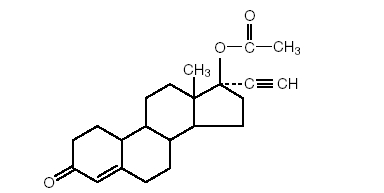
Norethindrone acetate USP, (17-hydroxy-19-nor-17α-pregn-4-en-20-yn-3-one acetate), a synthetic, orally active progestin, is the acetic acid ester of norethindrone. It is a white, or creamy white, crystalline powder.
Norethindrone acetate tablets USP, 5 mg contain the following inactive ingredients: colloidal silicon dioxide, lactose monohydrate, magnesium stearate, microcrystalline cellulose and talc.
CLINICAL PHARMACOLOGY
Norethindrone acetate induces secretory changes in an estrogen-primed endometrium. On a weight basis, it is twice as potent as norethindrone.
PHARMACOKINETICS
Absorption:
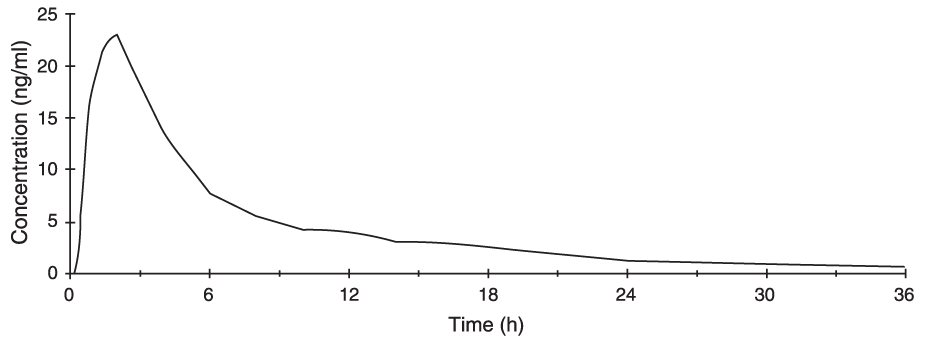
Norethindrone acetate is completely and rapidly deacetylated to norethindrone (NET) after oral administration, and the disposition of norethindrone acetate is indistinguishable from that of orally administered norethindrone. Norethindrone acetate is rapidly absorbed from norethindrone acetate tablets, with maximum plasma concentration of norethindrone generally occurring at about 2 hours post-dose. The pharmacokinetic parameters of norethindrone following single oral administration of norethindrone acetate in 29 healthy female volunteers are summarized in Table 1.
Norethindrone Acetate (n=29) Arithmetic Mean ± SD | |
Norethindrone (NET) | |
AUC (0-inf) (ng/ml•h) | 166.90 ± 56.28 |
C max (ng/ml) | 26.19 ± 6.19 |
t max (h) | 1.83 ± 0.58 |
t 1/2 (h) | 8.51 ± 2.19 |
AUC = area under the curve, | |
C max = maximum plasma concentration, | |
t max = time at maximum plasma concentration, | |
t 1/2 = half-life, | |
SD = standard deviation | |
Figure 1. Mean Plasma Concentration Profile after a Single Dose of 5 mg Administered to 29 Healthy Female Volunteers under Fasting Conditions
Effect of Food:
The effect of food administration on the pharmacokinetics of norethindrone acetate has not been studied.
Distribution:
Norethindrone is 36% bound to sex hormone-binding globulin (SHBG) and 61% bound to albumin. Volume of distribution of norethindrone is about 4 L/kg.
Metabolism:
Norethindrone undergoes extensive biotransformation, primarily via reduction, followed by sulfate and glucuronide conjugation. The majority of metabolites in the circulation are sulfates, with glucuronides accounting for most of the urinary metabolites.
Excretion:
Plasma clearance value for norethindrone is approximately 0.4 L/hr/kg. Norethindrone is excreted in both urine and feces, primarily as metabolites. The mean terminal elimination half-life of norethindrone following a single dose administration of norethindrone acetate is approximately 9 hours.
SPECIAL POPULATIONS
Geriatrics
The effect of age on the pharmacokinetics of norethindrone after norethindrone acetate administration has not been evaluated.
Race
The effect of race on the disposition of norethindrone after norethindrone acetate administration has not been evaluated.
Renal Insufficiency
The effect of renal disease on the disposition of norethindrone after norethindrone acetate administration has not been evaluated. In pre-menopausal women with chronic renal failure undergoing peritoneal dialysis who received multiple doses of an oral contraceptive containing ethinyl estradiol and norethindrone, plasma norethindrone concentration was unchanged compared to concentrations in pre-menopausal women with normal renal function.
Hepatic Insufficiency
The effect of hepatic disease on the disposition of norethindrone after norethindrone acetate administration has not been evaluated. However, norethindrone acetate is contraindicated in markedly impaired liver function or liver disease.
Drug Interactions
No pharmacokinetic drug interaction studies investigating any drug-drug interactions with norethindrone acetate have been conducted.
HOW SUPPLIED
Norethindrone acetate tablets USP are available as:
5 mg: White to off-white oval, flat faced beveled edged, uncoated tablets debossed with ‘G with breakline’ on one side and 304 on other side.
Available as follows:
Bottles of 50 NDC 68462-304-50 Bottles of 500 NDC 68462-304-05
