Get your patient on Pentobarbital Sodium - Pentobarbital Sodium injection, Solution (Pentobarbital Sodium)
Pentobarbital Sodium - Pentobarbital Sodium injection, Solution prescribing information

INDICATIONS AND USAGE
Parenteral
- Sedatives.
- Hypnotics, for the short-term treatment of insomnia, since they appear to lose their effectiveness for sleep induction and sleep maintenance after 2 weeks (See " Clinical Pharmacology " section).
- Preanesthetics.
- Anticonvulsant, in anesthetic doses, in the emergency control of certain acute convulsive episodes, e.g., those associated with status epilepticus, cholera, eclampsia, meningitis, tetanus, and toxic reactions to strychnine or local anesthetics.
DOSAGE AND ADMINISTRATION
Dosages of barbiturates must be individualized with full knowledge of their particular characteristics and recommended rate of administration. Factors of consideration are the patient's age, weight, and condition. Parenteral routes should be used only when oral administration is impossible or impractical.
Intramuscular Administration
IM injection of the sodium salts of barbiturates should be made deeply into a large muscle, and a volume of 5 mL should not be exceeded at any one site because of possible tissue irritation. After IM injection of a hypnotic dose, the patient's vital signs should be monitored. The usual adult dosage of Pentobarbital Sodium is 150 to 200 mg as a single IM injection; the recommended pediatric dosage ranges from 2 to 6 mg/kg as a single IM injection not to exceed 100 mg.
Intravenous Administration
Pentobarbital Sodium should not be admixed with any other medication or solution. IV injection is restricted to conditions in which other routes are not feasible, either because the patient is unconscious (as in cerebral hemorrhage, eclampsia, or status epilepticus), or because the patient resists (as in delirium), or because prompt action is imperative. Slow IV injection is essential, and patients should be carefully observed during administration. This requires that blood pressure, respiration, and cardiac function be maintained, vital signs be recorded, and equipment for resuscitation and artificial ventilation be available. The rate of IV injection should not exceed 50 mg/min for Pentobarbital Sodium.
There is no average intravenous dose of Pentobarbital Sodium that can be relied on to produce similar effects in different patients. The possibility of overdose and respiratory depression is remote when the drug is injected slowly in fractional doses.
A commonly used initial dose for the 70 kg adult is 100 mg. Proportional reduction in dosage should be made for pediatric or debilitated patients. At least one minute is necessary to determine the full effect of intravenous pentobarbital. If necessary, additional small increments of the drug may be given up to a total of from 200 to 500 mg for normal adults.
Anticonvulsant use
In convulsive states, dosage of Pentobarbital Sodium should be kept to a minimum to avoid compounding the depression which may follow convulsions. The injection must be made slowly with due regard to the time required for the drug to penetrate the blood-brain barrier.
Special patient population
Dosage should be reduced in the elderly or debilitated because these patients may be more sensitive to barbiturates. Dosage should be reduced for patients with impaired renal function or hepatic disease.
Inspection
Parenteral drug products should be inspected visually for particulate matter and discoloration prior to administration, whenever solution containers permit. Solutions for injection showing evidence of precipitation should not be used.
CONTRAINDICATIONS
Barbiturates are contraindicated in patients with known barbiturate sensitivity. Barbiturates are also contraindicated in patients with a history of manifest or latent porphyria.
ADVERSE REACTIONS
The following adverse reactions and their incidence were compiled from surveillance of thousands of hospitalized patients. Because such patients may be less aware of certain of the milder adverse effects of barbiturates, the incidence of these reactions may be somewhat higher in fully ambulatory patients.
More than 1 in 100 patients. The most common adverse reaction estimated to occur at a rate of 1 to 3 patients per 100 is: Nervous System: Somnolence.
Less than 1 in 100 patients. Adverse reactions estimated to occur at a rate of less than 1 in 100 patients listed below, grouped by organ system, and by decreasing order of occurrence are: Nervous system: Agitation, confusion, hyperkinesia, ataxia, CNS depression, nightmares, nervousness, psychiatric disturbance, hallucinations, insomnia, anxiety, dizziness, thinking abnormality. Respiratory system: Hypoventilation, apnea. Cardiovascular system: Bradycardia, hypotension, syncope. Digestive system: Nausea, vomiting, constipation. Other reported reactions: Headache, injection site reactions, hypersensitivity reactions (angioedema, skin rashes, exfoliative dermatitis), fever, liver damage, megaloblastic anemia following chronic phenobarbital use.
To report SUSPECTED ADVERSE REACTIONS, contact Hikma Pharmaceuticals USA Inc. at 1-877-845-0689 or FDA at 1-800-FDA-1088 or www.fda.gov/medwatch .
Drug interactions
Most reports of clinically significant drug interactions occurring with the barbiturates have involved phenobarbital. However, the application of these data to other barbiturates appears valid and warrants serial blood level determinations of the relevant drugs when there are multiple therapies.
- Anticoagulants: Phenobarbital lowers the plasma levels of dicumarol (name previously used: bishydroxycoumarin) and causes a decrease in anticoagulant activity as measured by the prothrombin time. Barbiturates can induce hepatic microsomal enzymes resulting in increased metabolism and decreased anticoagulant response of oral anticoagulants (e.g., warfarin, acenocoumarol, dicumarol, and phenprocoumon). Patients stabilized on anticoagulant therapy may require dosage adjustments if barbiturates are added to or withdrawn from their dosage regimen.
- Corticosteroids: Barbiturates appear to enhance the metabolism of exogenous corticosteroids probably through the induction of hepatic microsomal enzymes. Patients stabilized on corticosteroid therapy may require dosage adjustments if barbiturates are added to or withdrawn from their dosage regimen.
- Griseofulvin: Phenobarbital appears to interfere with the absorption of orally administered griseofulvin, thus decreasing its blood level. The effect of the resultant decreased blood levels of griseofulvin on therapeutic response has not been established. However, it would be preferable to avoid concomitant administration of these drugs.
- Doxycycline: Phenobarbital has been shown to shorten the half-life of doxycycline for as long as 2 weeks after barbiturate therapy is discontinued. This mechanism is probably through the induction of hepatic microsomal enzymes that metabolize the antibiotic. If phenobarbital and doxycycline are administered concurrently, the clinical response to doxycycline should be monitored closely.
- Phenytoin, sodium valproate, valproic acid: The effect of barbiturates on the metabolism of phenytoin appears to be variable. Some investigators report an accelerating effect, while others report no effect. Because the effect of barbiturates on the metabolism of phenytoin is not predictable, phenytoin and barbiturate blood levels should be monitored more frequently if these drugs are given concurrently. Sodium valproate and valproic acid appear to decrease barbiturate metabolism; therefore, barbiturate blood levels should be monitored and appropriate dosage adjustments made as indicated.
- Central nervous system depressants: The concomitant use of other central nervous system depressants, including other sedatives or hypnotics, antihistamines, tranquilizers, or alcohol, may produce additive depressant effects.
- Monoamine oxidase inhibitors (MAOI): MAOI prolong the effects of barbiturates probably because metabolism of the barbiturate is inhibited.
- Estradiol, estrone, progesterone and other steroidal hormones: Pretreatment with or concurrent administration of phenobarbital may decrease the effect of estradiol by increasing its metabolism. There have been reports of patients treated with antiepileptic drugs (e.g., phenobarbital) who became pregnant while taking oral contraceptives. An alternate contraceptive method might be suggested to women taking phenobarbital.
DESCRIPTION
The barbiturates are nonselective central nervous system depressants which are primarily used as sedative hypnotics and also anticonvulsants in subhypnotic doses. The barbiturates and their sodium salts are subject to control under the Federal Controlled Substances Act (See " Drug Abuse and Dependence " section).
The sodium salts of amobarbital, pentobarbital, phenobarbital, and secobarbital are available as sterile parenteral solutions.
Barbiturates are substituted pyrimidine derivatives in which the basic structure common to these drugs is barbituric acid, a substance which has no central nervous system (CNS) activity. CNS activity is obtained by substituting alkyl, alkenyl, or aryl groups on the pyrimidine ring.
Pentobarbital Sodium Injection, USP is a sterile solution for intravenous or intramuscular injection. Each mL contains pentobarbital sodium 50 mg, in a vehicle of propylene glycol, 40%, alcohol, 10% v/v and water for injection, to volume. The pH is adjusted to approximately 9.5 with hydrochloric acid and/or sodium hydroxide.
Pentobarbital Sodium Injection, USP is a short-acting barbiturate, chemically designated as sodium 5-ethyl-5-(1-methylbutyl) barbiturate. The structural formula for Pentobarbital Sodium is:
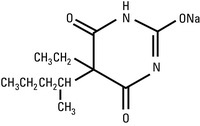
The sodium salt occurs as a white, slightly bitter powder which is freely soluble in water and alcohol but practically insoluble in benzene and ether.
CLINICAL PHARMACOLOGY
Barbiturates are capable of producing all levels of CNS mood alteration from excitation to mild sedation, to hypnosis, and deep coma. Overdosage can produce death. In high enough therapeutic doses, barbiturates induce anesthesia.
Barbiturates depress the sensory cortex, decrease motor activity, alter cerebellar function, and produce drowsiness, sedation, and hypnosis.
Barbiturate-induced sleep differs from physiological sleep. Sleep laboratory studies have demonstrated that barbiturates reduce the amount of time spent in the rapid eye movement (REM) phase of sleep or dreaming stage. Also, Stages III and IV sleep are decreased. Following abrupt cessation of barbiturates used regularly, patients may experience markedly increased dreaming, nightmares, and/or insomnia. Therefore, withdrawal of a single therapeutic dose over 5 or 6 days has been recommended to lessen the REM rebound and disturbed sleep which contribute to drug withdrawal syndrome (for example, decrease the dose from 3 to 2 doses a day for 1 week).
In studies, secobarbital sodium and pentobarbital sodium have been found to lose most of their effectiveness for both inducing and maintaining sleep by the end of 2 weeks of continued drug administration at fixed doses. The short-, intermediate-, and, to a lesser degree, long-acting barbiturates have been widely prescribed for treating insomnia. Although the clinical literature abounds with claims that the short-acting barbiturates are superior for producing sleep while the intermediate-acting compounds are more effective in maintaining sleep, controlled studies have failed to demonstrate these differential effects. Therefore, as sleep medications, the barbiturates are of limited value beyond short-term use.
Barbiturates have little analgesic action at subanesthetic doses. Rather, in subanesthetic doses these drugs may increase the reaction to painful stimuli. All barbiturates exhibit anticonvulsant activity in anesthetic doses. However, of the drugs in this class, only phenobarbital, mephobarbital, and metharbital have been clinically demonstrated to be effective as oral anticonvulsants in subhypnotic doses.
Barbiturates are respiratory depressants. The degree of respiratory depression is dependent upon dose. With hypnotic doses, respiratory depression produced by barbiturates is similar to that which occurs during physiologic sleep with slight decrease in blood pressure and heart rate.
Studies in laboratory animals have shown that barbiturates cause reduction in the tone and contractility of the uterus, ureters, and urinary bladder. However, concentrations of the drugs required to produce this effect in humans are not reached with sedative-hypnotic doses.
Barbiturates do not impair normal hepatic function, but have been shown to induce liver microsomal enzymes, thus increasing and/or altering the metabolism of barbiturates and other drugs. (See " Precautions - Drug Interactions " section).
Pharmacokinetics
Barbiturates are absorbed in varying degrees following oral, rectal, or parenteral administration. The salts are more rapidly absorbed than are the acids.
The onset of action for oral or rectal administration varies from 20 to 60 minutes. For IM administration, the onset of action is slightly faster. Following IV administration, the onset of action ranges from almost immediately for Pentobarbital Sodium to 5 minutes for phenobarbital sodium. Maximal CNS depression may not occur until 15 minutes or more after IV administration for phenobarbital sodium.
Duration of action, which is related to the rate at which the barbiturates are redistributed throughout the body, varies among persons and in the same person from time to time.
No studies have demonstrated that the different routes of administration are equivalent with respect to bioavailability.
Barbiturates are weak acids that are absorbed and rapidly distributed to all tissues and fluids with high concentrations in the brain, liver, and kidneys. Lipid solubility of the barbiturates is the dominant factor in their distribution within the body. The more lipid soluble the barbiturate, the more rapidly it penetrates all tissues of the body. Barbiturates are bound to plasma and tissue proteins to a varying degree with the degree of binding increasing directly as a function of lipid solubility.
Phenobarbital has the lowest lipid solubility, lowest plasma binding, lowest brain protein binding, the longest delay in onset of activity, and the longest duration of action. At the opposite extreme is secobarbital which has the highest lipid solubility, plasma protein binding, brain protein binding, the shortest delay in onset of activity, and the shortest duration of action. Butabarbital is classified as an intermediate barbiturate.
The plasma half-life for pentobarbital in adults is 15 to 50 hours and appears to be dose dependent.
Barbiturates are metabolized primarily by the hepatic microsomal enzyme system, and the metabolic products are excreted in the urine, and less commonly, in the feces. Approximately 25 to 50 percent of a dose of aprobarbital or phenobarbital is eliminated unchanged in the urine, whereas the amount of other barbiturates excreted unchanged in the urine is negligible. The excretion of unmetabolized barbiturate is one feature that distinguishes the long-acting category from those belonging to other categories which are almost entirely metabolized. The inactive metabolites of the barbiturates are excreted as conjugates of glucuronic acid.
HOW SUPPLIED
Pentobarbital Sodium Injection, USP is available in the following sizes:
20-mL multiple-dose vial, 1000 mg per vial (NDC 24201-010-20); and 50-mL multiple-dose vial, 2500 mg per vial (NDC 24201-010-50).
Each mL contains: Pentobarbital Sodium, derivative of barbituric acid - 50 mg
Propylene glycol - 40% v/v
Alcohol - 10% v/v
Water for Injection - qs
(pH adjusted to approximately 9.5 with hydrochloric acid and/or sodium hydroxide.)
The container closure is not made with natural rubber latex.
Exposure of pharmaceutical products to heat should be minimized. Avoid excessive heat. Protect from freezing. It is recommended that the product be stored at 20-25°C (68-77°F), however, brief excursions are permitted between 15-30°C (59-86°F). See USP controlled room temperature.
