Get your patient on Phentolamine Mesylate - Phentolamine Mesylate injection (Phentolamine Mesylate)
Phentolamine Mesylate - Phentolamine Mesylate injection prescribing information

INDICATIONS AND USAGE
Phentolamine Mesylate for Injection, USP is indicated for the prevention or control of hypertensive episodes that may occur in a patient with pheochromocytoma as a result of stress or manipulation during preoperative preparation and surgical excision.
Phentolamine Mesylate for Injection, USP is indicated for the prevention or treatment of dermal necrosis and sloughing following intravenous administration or extravasation of norepinephrine.
Phentolamine Mesylate for Injection, USP is also indicated for the diagnosis of pheochromocytoma by the Phentolamine Mesylate for Injection, USP blocking test.
DOSAGE AND ADMINISTRATION
The reconstituted solution should be used upon preparation and should not be stored. Note: Parenteral drug products should be inspected visually for particulate matter and discoloration prior to administration, whenever solution and container permit.
Prevention or control of hypertensive episodes in the patient with pheochromocytoma.
For preoperative reduction of elevated blood pressure, 5 mg of Phentolamine Mesylate for Injection, USP (1mg for children) is injected intravenously or intramuscularly 1 or 2 hours before surgery, and repeated if necessary.
During surgery, Phentolamine Mesylate for Injection, USP (5 mg for adults, 1 mg for children) is administered intravenously as indicated, to help prevent or control paroxysms of hypertension, tachycardia, respiratory depression, convulsions, or other effects of epinephrine intoxication. (Postoperatively, norepinephrine may be given to control the hypotension that commonly follows complete removal of a pheochromocytoma.)
Prevention or treatment of dermal necrosis and sloughing following intravenous administration or extravasation of norepinephrine.
For Prevention: 10 mg of Phentolamine Mesylate for Injection, USP is added to each liter of solution containing norepinephrine. The pressor effect of norepinephrine is not affected.
For Treatment: 5-10 mg of Phentolamine Mesylate for Injection, USP in 10 mL of saline is injected into the area of extravasation within 12 hours.
Diagnosis of pheochromocytoma — Phentolamine Mesylate for Injection, USP blocking test.
The test is most reliable in detecting pheochromocytoma in patients with sustained hypertension and least reliable in those with paroxysmal hypertension. False-positive tests may occur in patients with hypertension without pheochromocytoma.
a. Intravenous
Preparation
The CONTRAINDICATIONS , WARNINGS , and PRECAUTIONS sections should be reviewed. Sedatives, analgesics, and all other medications except those that might be deemed essential (such as digitalis and insulin) are withheld for at least 24 hours, and preferably 48 -72 hours, prior to the test. Antihypertensive drugs are withheld until blood pressure returns to the untreated, hypertensive level. This test is not performed on a patient who is normotensive.
Procedure
The patient is kept at rest in the supine position throughout the test, preferably in a quiet, darkened room. Injection of Phentolamine Mesylate for Injection, USP is delayed until blood pressure is stabilized, as evidenced by blood pressure readings taken every 10 minutes for at least 30 minutes.
Five milligrams of Phentolamine Mesylate for Injection, USP is dissolved in 1mL of Sterile Water for Injection. The dose for adults is 5 mg; for children, 1 mg.
The syringe needle is inserted into the vein, and injection is delayed until pressor response to venipuncture has subsided.
Phentolamine Mesylate for Injection, USP is injected rapidly. Blood pressure is recorded immediately after injection, at 30-second intervals for the first 3 minutes, and at 60-second intervals for the next 7 minutes.
Interpretation
A positive response, suggestive of pheochromocytoma, is indicated when the blood pressure is reduced more than 35 mmHg systolic and 25 mmHg diastolic. A typical positive response is a reduction in pressure of 60 mmHg systolic and 25 mmHg diastolic. Usually, maximal effect is evident within 2 minutes after injection. A return to preinjection pressure commonly occurs within 15-30 minutes but may occur more rapidly.
If blood pressure decreases to a dangerous level, the patient should be treated as outlined under OVERDOSAGE .
A positive response should always be confirmed by other diagnostic procedures, preferably by measurement of urinary catecholamines or their metabolites.
A negative response is indicated when the blood pressure is elevated, unchanged, or reduced less than 35 mmHg, systolic and 25 mmHg diastolic after injection of Phentolamine Mesylate for Injection, USP. A negative response to this test does not exclude the diagnosis of pheochromocytoma, especially in patients with paroxysmal hypertension in whom the incidence of false-negative responses is high.
b. Intramuscular
If the intramuscular test for pheochromocytoma is preferred, preparation is the same as for the intravenous test. Five milligrams of Phentolamine Mesylate for Injection, USP is then dissolved in 1mL of Sterile Water for Injection. The dose for adults is 5 mg intramuscularly; for children, 3 mg. Blood pressure is recorded every 5 minutes for 30-45 minutes following injection. A positive response is indicated when the blood pressure is reduced 35 mmHg systolic and 25 mmHg diastolic, or more, within 20 minutes following injection.
CONTRAINDICATIONS
Myocardial infarction, history of myocardial infarction, coronary insufficiency, angina or other evidence suggestive of coronary artery disease; hypersensitivity to phentolamine or related compounds.
ADVERSE REACTIONS
Acute and prolonged hypotensive episodes, tachycardia, and cardiac arrhythmias have been reported. In addition, weakness, dizziness, flushing, orthostatic hypotension, nasal stuffiness, nausea, vomiting, and diarrhea may occur. To report SUSPECTED ADVERSE REACTIONS, contact Precision Dose Inc. at 1-844-668-3942 or FDA at 1-800-FDA-1088 or www.fda.gov/medwatch.
Drug Interactions
DESCRIPTION
Phentolamine Mesylate for Injection, USP is an antihypertensive, available in vials for intravenous and intramuscular administration. Each vial contains phentolamine mesylate, USP, 5 mg, and mannitol USP, 25 mg, in sterile, lyophilized form.
Phentolamine Mesylate, USP is 4,5-dihydro-2-[N-( m -hydroxyphenyl)-N-( p -methylphenyl) amino methyl]-1 H - imidazole 1:1 methanesulfonate, and its structural formula is
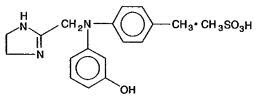
Phentolamine mesylate, USP is a white or off-white, odorless crystalline powder with a molecular weight of 377.46. Its solutions are acid to litmus. It is freely soluble in water and in alcohol, and slightly soluble in chloroform. It melts at about 178°C.
CLINICAL PHARMACOLOGY
Phentolamine Mesylate for Injection, USP produces an alpha-adrenergic block of relatively short duration. It also has direct, but less marked, positive inotropic and chronotropic effects on cardiac muscle and vasodilator effects on vascular smooth muscle.
Phentolamine Mesylate for Injection, USP has a half-life in the blood of 19 minutes following intravenous administration. Approximately 13% of a single intravenous dose appears in the urine as unchanged drug.
HOW SUPPLIED
Vials— each containing 5 mg of Phentolamine mesylate, USP, and 25 mg of mannitol, USP, in sterile, lyophilized form. Trays of 10 with NDC 68094-101-10 Cartons of 1 with NDC 68094-101-20
The reconstituted solution should be used upon preparation and should not be stored.
Store at 20° to 25°C (68° - 77°F) with excursions between 15° to 30°C (59° to 86°F) [USP Controlled Room Temperature]
You can also call Precision Dose Inc. at 1-800-397-9228 or visit www.precisiondose.com.
Distributed by: Precision Dose, Inc. South Beloit, IL 61080
Revised: 10/2017
