Get your patient on Primidone - Primidone tablet (Primidone)
Primidone - Primidone tablet prescribing information

INDICATIONS AND USAGE
Primidone, used alone or concomitantly with other anticonvulsants, is indicated in the control of grand mal, psychomotor, and focal epileptic seizures. It may control grand mal seizures refractory to other anticonvulsant therapy.
DOSAGE AND ADMINISTRATION
Usual Dosage
Patients 8 years of age and older who have received no previous treatment may be started on primidone tablets according to the following regimen using either 50 mg or scored 250 mg primidone tablets:
Days 1 to 3: 100 to 125 mg at bedtime. Days 4 to 6: 100 to 125 mg twice a day. Days 7 to 9: 100 to 125 mg three times a day. Day 10 to maintenance: 250 mg three times a day.
For most adults and children 8 years of age and over, the usual maintenance dosage is three to four 250 mg primidone tablets in divided doses (250 mg three times a day or four times a day). If required, an increase to five or six 250 mg tablets daily may be made, but daily doses should not exceed 500 mg four times a day.
Dosage should be individualized to provide maximum benefit. In some cases, serum blood level determinations of primidone may be necessary for optimal dosage adjustment. The clinically effective serum level for primidone is between 5 to 12 mcg/mL.
| INITIAL: ADULTS AND CHILDREN OVER 8 | ||||||
|---|---|---|---|---|---|---|
| KEY: •=50 mg tablet; ●=250 mg tablet | ||||||
DAY | 1 | 2 | 3 | 4 | 5 | 6 |
AM | •• | •• | •• | |||
NOON | ||||||
PM | •• | •• | •• | •• | •• | •• |
DAY | 7 | 8 | 9 | 10 | 11 | 12 |
AM | •• | •• | •• | Adjust to Maintenance | ||
NOON | •• | •• | •• | |||
PM | •• | •• | •• | |||
Patients Already Receiving Other Anticonvulsants
Primidone tablets should be started at 100 to 125 mg at bedtime and gradually increased to maintenance level as the other drug is gradually decreased. This regimen should be continued until satisfactory dosage level is achieved for the combination, or the other medication is completely withdrawn. When therapy with primidone tablets alone is the objective, the transition from concomitant therapy should not be completed in less than 2 weeks.
Pediatric Dosage
For children under 8 years of age, the following regimen may be used:
Days 1 to 3: 50 mg at bedtime. Days 4 to 6: 50 mg twice a day. Days 7 to 9: 100 mg twice a day. Day 10 to maintenance: 125 mg three times a day to 250 mg three times a day.
For children under 8 years of age, the usual maintenance dosage is 125 to 250 mg three times daily or, 10 to 25 mg/kg/day in divided doses.
CONTRAINDICATIONS
Primidone is contraindicated in: 1) patients with porphyria and 2) patients who are hypersensitive to phenobarbital (see ACTIONS ).
ADVERSE REACTIONS
The most frequently occurring early side effects are ataxia and vertigo. These tend to disappear with continued therapy, or with reduction of initial dosage. Occasionally, the following have been reported: nausea, anorexia, vomiting, fatigue, hyperirritability, emotional disturbances, sexual impotency, diplopia, nystagmus, drowsiness, and morbilliform skin eruptions. Granulocytopenia, agranulocytosis, and red-cell hypoplasia and aplasia, have been reported rarely. These and, occasionally, other persistent or severe side effects may necessitate withdrawal of the drug. Megaloblastic anemia may occur as a rare idiosyncrasy to primidone and to other anticonvulsants. The anemia responds to folic acid without necessity of discontinuing medication.
To report SUSPECTED ADVERSE REACTIONS, contact Advagen Pharma Ltd, at 866- 488-0312 or FDA at 1-800-FDA-1088 or www.fda.gov/medwatch .
DESCRIPTION
Chemical name: 5-ethyldihydro-5-phenyl-4,6 (1H, 5H)-pyrimidinedione. Structural formula:
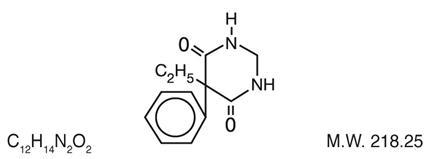
Primidone is a white, crystalline, highly stable substance, M.P. 279-284°C. It is poorly soluble in water (60 mg per 100 mL at 37°C) and in most organic solvents. It possesses no acidic properties, in contrast to its barbiturate analog.
Primidone Tablets, USP 50 mg, 125 mg and 250 mg contain the following inactive ingredients: lactose monohydrate, NF; magnesium stearate, NF; hypromellose, USP; microcrystalline cellulose, NF; purified water, USP; sodium lauryl sulfate, NF; sodium starch glycolate, NF; and talc, USP/NF.
_______________________________________________________________________________
.
ACTIONS
Primidone tablets raises electro- or chemoshock seizure thresholds or alters seizure patterns in experimental animals. The mechanism(s) of primidone's antiepileptic action is not known.
Primidone per se has anticonvulsant activity as do its two metabolites, phenobarbital and phenylethylmalonamide (PEMA). In addition to its anticonvulsant activity, PEMA potentiates the anticonvulsant activity of phenobarbital in experimental animals.
HOW SUPPLIED
Primidone Tablets, USP
50 mg : White to off white, round tablets debossed with ‘Λ’ on one side and scored on the other side in bottles of 100 (NDC72888-045-01) and 500 (NDC72888-045-05). 39
125 mg : White to off-white, round tablets, debossed with ‘ΛH5’ on one side and plain on the other side. They are supplied as follows: Bottles of 30, NDC 72888-160-30 Bottles of 100, NDC 72888-160-01 Bottles of 500, NDC 72888-160-05 Bottles of 1,000, NDC 72888-160-00
250 mg : White to off-white, round, scored tablets debossed with ‘Λ’ above the score line & ‘40’ below the score line on one side and plain on the other side in bottles of 100 (NDC72888-046-01) and 500 (NDC72888-046-05).
Storage
Store at 20° to 25°C (68° to 77°F); excursions permitted to 15° to 30°C (59° to 86°F) [see USP Controlled Room Temperature].
Dispense in a tight, light-resistant container with a child-resistant closure.
Distributed by: Advagen Pharma Ltd., East Windsor, NJ 08520, USA
Manufactured by: Rubicon Research Limited Thane, 421506 India.
Trademarks are the property of their respective owners.
Rev. 12/2022
ACTIONS
Primidone tablets raises electro- or chemoshock seizure thresholds or alters seizure patterns in experimental animals. The mechanism(s) of primidone's antiepileptic action is not known.
Primidone per se has anticonvulsant activity as do its two metabolites, phenobarbital and phenylethylmalonamide (PEMA). In addition to its anticonvulsant activity, PEMA potentiates the anticonvulsant activity of phenobarbital in experimental animals.
