Get your patient on Pyrimethamine - Pyrimethamine tablet (Pyrimethamine)
Pyrimethamine - Pyrimethamine tablet prescribing information

INDICATIONS AND USAGE
Treatment of Toxoplasmosis: Pyrimethamine is indicated for the treatment of toxoplasmosis when used conjointly with a sulfonamide, since synergism exists with this combination.
DOSAGE AND ADMINISTRATION
For Treatment of Toxoplasmosis: The dosage of pyrimethamine for the treatment of toxoplasmosis must be carefully adjusted so as to provide maximum therapeutic effect and a minimum of side effects. At the dosage required, there is a marked variation in the tolerance to the drug. Young patients may tolerate higher doses than older individuals. Concurrent administration of folinic acid is strongly recommended in all patients.
The adult starting dose is 50 to 75 mg of the drug daily, together with 1 to 4 g daily of a sulfonamide of the sulfapyrimidine type, e.g. sulfadoxine. This dosage is ordinarily continued for 1 to 3 weeks, depending on the response of the patient and tolerance to therapy. The dosage may then be reduced to about one half that previously given for each drug and continued for an additional 4 to 5 weeks. The pediatric dosage of pyrimethamine is 1 mg/kg/day divided into 2 equal daily doses; after 2 to 4 days this dose may be reduced to one half and continued for approximately 1 month. The usual pediatric sulfonamide dosage is used in conjunction with pyrimethamine.
CONTRAINDICATIONS
Use of pyrimethamine is contraindicated in patients with known hypersensitivity to pyrimethamine or to any component of the formulation. Use of the drug is also contraindicated in patients with documented megaloblastic anemia due to folate deficiency.
ADVERSE REACTIONS
Hypersensitivity reactions, occasionally severe (such as Stevens- Johnson syndrome, toxic epidermal necrolysis, erythema multiforme, and anaphylaxis), and hyperphenylalaninemia, can occur particularly when pyrimethamine is administered concomitantly with a sulfonamide. Consult the complete prescribing information for the relevant sulfonamide for sulfonamide-associated adverse events. With doses of pyrimethamine used for the treatment of toxoplasmosis, anorexia and vomiting may occur. Vomiting may be minimized by giving the medication with meals; it usually disappears promptly upon reduction of dosage. Doses used in toxoplasmosis may produce megaloblastic anemia, leukopenia, thrombocytopenia, pancytopenia, neutropenia, atrophic glossitis, hematuria, and disorders of cardiac rhythm
Hematologic effects, however, may also occur at low doses in certain individuals (see PRECAUTIONS; General ).
Pulmonary eosinophilia has been reported rarely.
Drug Interactions: Pyrimethamine may be used with sulfonamides, quinine and other antimalarials, and with other antibiotics. However, the concomitant use of other antifolic drugs or agents associated with myelosuppression including sulfonamides or trimethoprim- sulfamethoxazole combinations, proguanil, zidovudine, or cytostatic agents (e.g., methotrexate), while the patient is receiving pyrimethamine, may increase the risk of bone marrow suppression. If signs of folate deficiency develop, pyrimethamine should be discontinued. Folinic acid (leucovorin) should be administered until normal hematopoiesis is restored (see WARNINGS ). Mild hepatotoxicity has been reported in some patients when lorazepam and pyrimethamine were administered concomitantly.
DESCRIPTION
Pyrimethamine is an antiparasitic compound available in tablet form for oral administration. Each scored tablet contains 25 mg pyrimethamine and the inactive ingredients corn and potato starch, lactose, and magnesium stearate.
Pyrimethamine, known chemically as 5-(4- chlorophenyl)-6-ethyl-2, 4-pyrimidinediamine, has the following structural formula:
C 12 H 13 CIN 4 Mol. Wt. 248.7 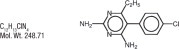
CLINICAL PHARMACOLOGY
Pyrimethamine is well absorbed with peak levels occurring between 2 to 6 hours following administration. It is eliminated slowly and has a plasma half-life of approximately 96 hours. Pyrimethamine is 87% bound to human plasma proteins.
Microbiology: Pyrimethamine is a folic acid antagonist and the rationale for its therapeutic action is based on the differential requirement between host and parasite for nucleic acid precursors involved in growth. This activity is highly selective against Toxoplasma gondii.
The action of pyrimethamine against Toxoplasma gondii is greatly enhanced when used in conjunction with sulfonamides. This was demonstrated by Eyles and Coleman 1 in the treatment of experimental toxoplasmosis in the mouse. Jacobs et al 2 demonstrated that combination of the 2 drugs effectively prevented the development of severe uveitis in most rabbits following the inoculation of the anterior chamber of the eye with toxoplasma.
HOW SUPPLIED:
White, scored tablets containing 25 mg pyrimethamine, imprinted with “Daraprim” and “A3A" in bottles of 100 (NDC 72647-330-01) and bottles of 30 (NDC 72647-330-03).
Store at 15° to 25°C (59° to 77°F) in a dry place and protect from light.
