Get your patient on Sodium Polystyrene Sulfonate - Sodium Polystyrene Sulfonate powder, For Suspension (Sodium Polystyrene Sulfonate)
Sodium Polystyrene Sulfonate - Sodium Polystyrene Sulfonate powder, For Suspension prescribing information

INDICATIONS AND USAGE
Sodium polystyrene sulfonate for suspension is indicated for the treatment of hyperkalemia.
DOSAGE AND ADMINISTRATION
Suspension of this drug should be freshly prepared and not stored beyond 24 hours.
The average daily adult dose of the resin is 15 g to 60 g. This is best provided by administering 15 g (approximately 4 level teaspoons) of sodium polystyrene sulfonate one to four times daily. One gram of sodium polystyrene sulfonate contains 4.1 mEq of sodium; one level teaspoon contains approximately 3.5 g of sodium polystyrene sulfonate and 15 mEq of sodium (A heaping teaspoon may contain as much as 10 g to 12 g of sodium polystyrene sulfonate). Since the in vivo efficiency of sodium-potassium exchange resins is approximately 33 percent, about one third of the resin's actual sodium content is being delivered to the body.
In smaller children and infants, lower doses should be employed by using as a guide a rate of 1 mEq of potassium per gram of resin as the basis for calculation
Each dose should be given as a suspension in a small quantity of water or, for greater palatability, in syrup. The amount of fluid usually ranges from 20 mL to 100 mL, depending on the dose, or may be simply determined by allowing 3 mL to 4 mL per gram of resin. Healthcare professionals should follow full aspiration precautions when administering this product, such as placing and maintaining the patient in an upright position while the resin is being administered.
The resin may be introduced into the stomach through a plastic tube and, if desired, mixed with a diet appropriate for a patient in renal failure.
The resin may also be given, although with less effective results, in an enema consisting (for adults) of 30 g to 50 g every six hours. Each dose is administered as a warm emulsion (at body temperature) in 100 mL of aqueous vehicle. The emulsion should be agitated gently during administration. The enema should be retained as long as possible and followed by a cleansing enema.
After an initial cleansing enema, a soft, large size (French 28) rubber tube is inserted into the rectum for a distance of about 20 cm, with the tip well into the sigmoid colon, and taped in place. The resin is then suspended in the appropriate amount of aqueous vehicle at body temperature and introduced by gravity, while the particles are kept in suspension by stirring. The suspension is flushed with 50 mL or 100 mL of fluid, following which the tube is clamped and left in place. If back leakage occurs, the hips are elevated on pillows or a knee-chest position is taken temporarily. A somewhat thicker suspension may be used, but care should be taken that no paste is formed, because the latter has a greatly reduced exchange surface and will be particularly ineffective if deposited in the rectal ampulla. The suspension is kept in the sigmoid colon for several hours, if possible. Then, the colon is irrigated with nonsodium containing solution at body temperature in order to remove the resin. Two quarts of flushing solution may be necessary. The returns are drained constantly through a Y tube connection. While the use of sorbitol is not recommended, particular attention should be paid to this cleansing enema if sorbitol has been used.
The intensity and duration of therapy depend upon the severity and resistance of hyperkalemia.
Sodium polystyrene sulfonate should not be heated for to do so may alter the exchange properties of the resin.
CONTRAINDICATIONS
Sodium polystyrene sulfonate is contraindicated in the following conditions: patients with hypokalemia, patients with a history of hypersensitivity to polystyrene sulfonate resins, obstructive bowel disease, neonates with reduced gut motility (postoperatively or drug induced) and oral administration in neonates.
(See PRECAUTIONS )
ADVERSE REACTIONS
Sodium polystyrene sulfonate may cause some degree of gastric irritation. Anorexia, nausea, vomiting, and constipation may occur especially if high doses are given. Also, hypokalemia, hypocalcemia, hypomagnesemia and significant sodium retention, and their related clinical manifestations, may occur (see WARNINGS ). Occasionally diarrhea develops. Large doses in elderly individuals may cause fecal impaction (see PRECAUTIONS ). Rare instances of intestinal necrosis have been reported. Intestinal obstruction due to concretions of aluminum hydroxide, when used in combination with sodium polystyrene sulfonate, has been reported.
The following events have been reported from worldwide post marketing experience:
- Fecal impaction following rectal administration, particularly in children;
- Gastrointestinal concretions (bezoars) following oral administration;
- Ischemic colitis, gastrointestinal tract ulceration or necrosis which could lead to intestinal perforation; and,
- Rare cases of acute bronchitis and/or broncho-pneumonia associated with inhalation of particles of polystyrene sulfonate.
Drug Interactions
Antacids
The simultaneous oral administration of sodium polystyrene sulfonate with nonabsorbable cation donating antacids and laxatives may reduce the resin's potassium exchange capability.
Non-absorbable cation-donating antacids and laxatives
Systemic alkalosis has been reported after cation-exchange resins were administered orally in combination with nonabsorbable cation-donating antacids and laxatives such as magnesium hydroxide and aluminum carbonate. Magnesium hydroxide should not be administered with sodium polystyrene sulfonate. One case of grand mal seizure has been reported in a patient with chronic hypocalcemia of renal failure who was given sodium polystyrene sulfonate with magnesium hydroxide as a laxative. Intestinal obstruction due to concretions of aluminum hydroxide when used in combination with sodium polystyrene sulfonate has been reported.
Digitalis
The toxic effects of digitalis on the heart, especially various ventricular arrhythmias and A-V nodal dissociation, are likely to be exaggerated by hypokalemia, even in the face of serum digoxin concentrations in the "normal range" (See WARNINGS ).
Sorbitol
Concomitant use of Sorbitol with sodium polystyrene sulfonate has been implicated in cases of intestinal necrosis, which may be fatal. Therefore, concomitant administration is not recommended (See WARNINGS ).
Lithium
Sodium polystyrene sulfonate may decrease absorption of lithium.
Thyroxine
Sodium polystyrene sulfonate may decrease absorption of thyroxine.
DESCRIPTION
Sodium polystyrene sulfonate is a benzene, diethenyl- polymer, with ethenylbenzene, sulfonated, sodium salt and has the following structural formula:
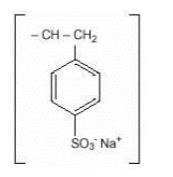
The drug is a golden brown finely ground, powdered form of sodium polystyrene sulfonate, a cation exchange resin prepared in the sodium phase with an in vitro exchange capacity of approximately 3.1 mEq ( in vivo approximately 1 mEq) of potassium per gram. The sodium content is approximately 100 mg (4.1 mEq) per gram of the drug. It can be administered orally or in an enema.
CLINICAL PHARMACOLOGY
As the resin passes along the intestine or is retained in the colon after administration by enema, the sodium ions are partially released and are replaced by potassium ions. For the most part, this action occurs in the large intestine, which excretes potassium ions to a greater degree than does the small intestine. The efficiency of this process is limited and unpredictably variable. It commonly approximates the order of 33 percent but the range is so large that definitive indices of electrolyte balance must be clearly monitored.
Metabolic data are unavailable.
HOW SUPPLIED
Sodium polystyrene sulfonate for suspension is available as a golden brown, finely ground powder in jars of 1 pound (454 g), NDC 10135-0146-17 and in bottles of 15 g, NDC 10135-0146-14. Store at 25° C (77° F); excursions permitted to 15° – 30° C (59° – 86° F) [see USP Controlled Room Temperature]
Rx Only
Manufactured for: Marlex Pharmaceuticals Inc. New Castle, DE 19720
Made in U.S.A
Rev. 03/16SP
