Get your patient on Vectical - Calcitriol ointment (Calcitriol)
Vectical - Calcitriol ointment prescribing information

INDICATIONS AND USAGE
Indication
VECTICAL Ointment is indicated for the topical treatment of mild to moderate plaque psoriasis in adults and pediatric patients 2 years and older.
Limitations of Use
The safety and effectiveness of VECTICAL Ointment in patients with known or suspected disorders of calcium metabolism have not been evaluated.
DOSAGE AND ADMINISTRATION
Apply VECTICAL Ointment to affected areas twice daily, morning and evening Adults: • The maximum weekly dose should not exceed 200 grams. Pediatrics: • 2 to 6 years of age: the maximum weekly dose should not exceed 100 grams • 7 years of age and older: the maximum weekly dose should not exceed 200 grams VECTICAL Ointment should not be applied to the eyes, lips, or facial skin. VECTICAL Ointment is for topical use only. VECTICAL Ointment is not for oral, ophthalmic or intravaginal use.
DOSAGE FORMS AND STRENGTHS
Ointment, 3 mcg/g. Each gram of VECTICAL Ointment contains 3 micrograms (mcg/g) of calcitriol.
USE IN SPECIFIC POPULATIONS
8.1 Pregnancy
Risk Summary Available data from pregnancies that occurred during the clinical development of VECTICAL Ointment and published case series of oral and intravenous calcitriol use in pregnant women have not identified a drug associated risk for major birth defects, miscarriages, or adverse maternal or fetal outcomes. In animal reproduction studies, topical administration of calcitriol to pregnant rabbits during the period of organogenesis resulted in an increased incidence of fetal deaths, as well as an increased incidence of minor skeletal abnormalities (see Data) . The available data do not allow the calculation of relevant comparisons between the systemic exposures of calcitriol observed in animal studies to the systemic exposures that would be expected in humans after topical use of VECTICAL Ointment. The background risk of major birth defects and miscarriage for the indicated population is unknown. All pregnancies have a background risk of birth defect, loss, or other adverse outcomes. In the U.S. general population, the estimated risk of major birth defects and miscarriage in clinically recognized pregnancies is 2 to 4% and 15 to 20%, respectively.
Data Animal Data Embryo-fetal development studies with calcitriol were performed in which rats were treated orally at dosages up to 0.9 mcg/kg/day (5.4 mcg/m 2 /day) and in which rabbits received topical application of calcitriol ointment (3 ppm) to 6.4% of the body surface area. No effects on reproductive or fetal parameters were observed in rats. In rabbits, topically applied calcitriol induced a significantly elevated mean post-implantation loss and an increased incidence of minor skeletal abnormalities due to delayed ossification of the pubic bones. A slightly increased incidence of skeletal variation (extra 13th rib, reduced ossification of epiphyses) was also observed. These effects may have been secondary to maternal toxicity.
Lactation
Risk Summary There are no data on the presence of calcitriol in human milk, the effects on the breastfed infant or on milk production after treatment with VECTICAL Ointment. It is not known whether topical administration of calcitriol could result in sufficient systemic absorption to produce detectable quantities in human milk. The developmental and health benefits of breastfeeding should be considered along with the mother’s clinical need for VECTICAL Ointment and any potential adverse effects on the breastfed infant from VECTICAL Ointment or from the underlying maternal conditions. Clinical Considerations Advise breastfeeding women not to apply VECTICAL Ointment directly to the nipple and areola to avoid direct infant exposure.
Pediatric Use
The safety and effectiveness of VECTICAL Ointment have been established in pediatric patients age 2 years and older for topical treatment of mild to moderate psoriasis. Use of VECTICAL Ointment in this age group is supported by two adequate and well-controlled 8-week trials and an open label trial in adult subjects, and additional data from trials conducted in pediatric subjects 2 to 17 years of age including;
- a vehicle controlled 8-week trial in 19 subjects 2 to 12 years of age with mild to moderate plaque psoriasis
- an open-label 8-week safety and pharmacokinetics (PK) trial in 25 subjects 12 to 17 years of age
- an open-label 14-day safety and PK trial in 18 subjects 2 to 12 years of age; and
- an open-label 26-week safety and PK trial in 54 subjects 2 to 17 years of age.
Data from 63 subjects ages 2 to 12 years, and 42 subjects ages 13 to 17 years showed no significant effects on indices of calcium metabolism. The systemic exposure of calcitriol in the pediatric subjects was generally comparable to the endogenous levels observed at baseline. No new safety signals were identified in subjects 2 to 17 years [see Clinical Studies (14 ), Clinical Pharmacology (12.3 ) and Adverse Reactions (6.1 )]. The safety and effectiveness of VECTICAL Ointment in pediatric subjects below the age of 2 years have not been established.
Geriatric Use
Clinical studies of VECTICAL Ointment did not include sufficient numbers of subjects aged 65 and over to determine whether they respond differently from younger subjects. Other reported experience has not identified differences in responses between the elderly and younger patients.
CONTRAINDICATIONS
None
WARNINGS AND PRECAUTIONS
Effects on Calcium Metabolism
In controlled clinical trials hypercalcemia was observed in subjects exposed to VECTICAL Ointment. If aberrations in parameters of calcium metabolism occur, treatment should be discontinued until these parameters have normalized. The effects of VECTICAL Ointment on calcium metabolism following treatment durations greater than 52 weeks have not been evaluated. Increased absorption may occur with occlusive use. VECTICAL Ointment should be used with caution in patients receiving medications known to increase the serum calcium level, such as thiazide diuretics, and in patients receiving calcium supplements or high doses of vitamin D.
ADVERSE REACTIONS
Clinical Trials Experience
Because clinical studies are conducted under widely varying conditions, adverse reaction rates observed in the clinical studies of a drug cannot be directly compared to rates in the clinical studies of another drug and may not reflect the rates observed in practice. VECTICAL Ointment was studied in two vehicle-controlled trials and one open label trial, resulting in 743 subjects exposed to VECTICAL Ointment. Table 1 describes adverse events in subjects treated with VECTICAL Ointment twice daily for 8 weeks. The population included subjects ages 13 to 87 years, males (284) and females (135), Caucasians (372) and non-Caucasians (47); with mild (105) to moderate (313) chronic plaque psoriasis.
Four hundred and nineteen subjects were treated with VECTICAL Ointment twice daily for 8 weeks. The population included subjects ages 13 to 87, males (284) and females (135), Caucasians (372) and non-Caucasians (47); with mild (105) to moderate (313) chronic plaque psoriasis.
| VECTICAL (n = 419) | Vehicle Ointment (n = 420) | |
| Discomfort skin | 3% | 2% |
| Pruritus | 1% | 1% |
Among subjects having laboratory monitoring, hypercalcemia was observed in 24% (18/74) of subjects exposed to active drug and in 16% (13/79) of subjects exposed to vehicle, the elevations were less than 10% above the upper limit of normal ) [see Warnings and Precautions (5.1 ) ].
The open label trial enrolled 324 subjects with psoriasis who were treated for up to 52 weeks and included 239 subjects exposed for 6 months and 116 subjects exposed for one year. Adverse events reported at a rate of greater than or equal to 3% of subjects treated with VECTICAL Ointment were lab test abnormality (8%), urine abnormality (4%), psoriasis (4%), hypercalciuria (3%), and discomfort of skin (3%). Kidney stones were reported in 3 subjects and confirmed in two.
Postmarketing Experience
The following adverse reactions have been identified during world-wide post-approval use of VECTICAL Ointment: acute blistering dermatitis, erythema and skin burning sensation. Because these reactions are reported voluntarily from a population of uncertain size, it is not always possible to reliably estimate their frequency or establish a causal relationship to drug exposure.
DESCRIPTION
VECTICAL (calcitriol) Ointment 3 mcg/g is a vitamin D analog intended for topical application to the skin. The chemical name of the active ingredient is (5Z,7E)-9,10-secocholesta-5,7,10(19)-triene-1α,3β,25-triol. The structural formula is:
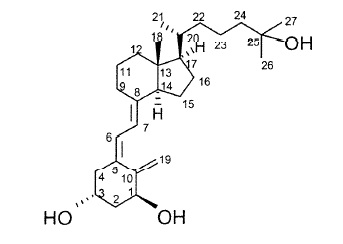
Calcitriol is a white or almost white crystalline solid. It is practically insoluble in water, soluble in alcohol and in fatty oils. The molecular formula is C 27 H 44 O 3 , and the molecular weight is 416.64.
VECTICAL Ointment is a translucent ointment containing 3 mcg/g (0.0003% w/w) of calcitriol, packaged in aluminum tubes with screw caps. Other components of the ointment are mineral oil, dl-α-tocopherol, and white petrolatum.
CLINICAL PHARMACOLOGY
The contribution to efficacy of individual components of the vehicle has not been established.
Mechanism of Action
The mechanism of action of calcitriol in the treatment of psoriasis has not been established.
Pharmacokinetics
The systemic exposure of calcitriol was assessed in subjects with chronic, plaque psoriasis. In the pivotal pharmacokinetic/pharmacodynamic study, calcitriol ointment 3 mcg/g, was applied twice daily for 21 days (for a total dose of 30 g/day) to 35% of the body surface area (psoriatic + surrounding healthy skin) of subjects with at least 25% of body surface area involvement. At Day 21, the geometric mean plasma concentration values of C max increased by approximately 36% over baseline and the geometric mean value of AUC (0 – 12 hr) increased by 44%. There was no correlation between the elevated calcitriol levels and the pharmacodynamic parameters of serum albumin adjusted calcium, serum phosphorus, urinary calcium and urinary phosphorus.
Specific Populations Pediatric Patients The systemic exposure of calcitriol was assessed in pediatric subjects ages 2 to 17 years with plaque psoriasis in two trials. In one trial, 25 subjects ages 12 to 17 applied calcitriol ointment 3 mcg/g twice a day for 8 weeks to a body surface area of 10% to 35%. The mean daily dose was 10.43 g/day. In the second trial, 17 subjects ages 2 to 12 applied calcitriol ointment 3 mcg/g twice a day for 14 days to a body surface area of 3% to 18%. The mean daily dose was 17.09 g/day. In both trials, the systemic concentrations of calcitriol post treatment were relatively flat and were generally comparable to the endogenous levels observed at baseline. The PK parameters could not be reliably estimated. There was no correlation between the elevated calcitriol levels and the pharmacodynamic parameters of serum albumin adjusted calcium, serum phosphorus, urinary calcium and urinary phosphorus.
NONCLINICAL TOXICOLOGY
Carcinogenesis, Mutagenesis, Impairment of Fertility
When calcitriol was applied topically to mice for up to 24 months, no significant changes in tumor incidence were observed. Concentrations of calcitriol in ointment base of 0 (vehicle control), 0.3, 0.6 and 1.0 ppm were evaluated.
A two-year carcinogenicity study was conducted in which calcitriol was orally administered to rats at dosages of approximately 0.005, 0.03, and 0.1 mcg/kg/day (0.03, 0.18, and 0.6 mcg/m 2 /day, respectively). The incidence of benign pheochromocytomas was significantly increased in female rats. No other significant differences in tumor incidence were observed.
Calcitriol did not elicit genotoxic effects in the mouse lymphoma TK locus assay. Studies in which male and female rats received oral doses of calcitriol of up to 0.6 mcg/kg/day (3.6 mcg/m 2 /day) indicated no impairment of fertility or general reproductive performance.
CLINICAL STUDIES
In two, multicenter, double-blind, vehicle-controlled studies, a total of 839 subjects with psoriasis rated "mild" or "moderate" using an investigator global assessment scale were treated twice daily for 8 weeks. Subjects were randomized in a 1:1 ratio to receive either VECTICAL Ointment or vehicle ointment. The mean age of the subjects was 48 years and 66% were male; most subjects were rated "moderate" at baseline.
Success was defined as "Clear or Minimal" (up to light red or pink in coloration, surface dryness with some white coloration, and slight elevation above normal skin) with at least a 2-grade change from baseline. The success rates are displayed in the Table 2.
| Study 1 | Study 2 | ||
| VECTICAL Ointment (N = 209) | Vehicle Ointment (N = 209) | VECTICAL Ointment (N = 210) | Vehicle Ointment (N = 211) |
| 23.4% | 14.4% | 20.5% | 6.6% |
HOW SUPPLIED/STORAGE AND HANDLING
How Supplied
VECTICAL Ointment 3 mcg/g is available in collapsible aluminum tubes of the following package sizes:
100 g tube (NDC 0299-2012-10)
Storage
Store at Controlled Room temperature 68° - 77°F (20° - 25°C) with excursions permitted between 59° - 86°F (15° - 30°C). [See USP Controlled Room Temperature.] Do not freeze or refrigerate.
Mechanism of Action
The mechanism of action of calcitriol in the treatment of psoriasis has not been established.
