Get your patient on Vusion - Miconazole Nitrate, Zinc Oxide, White Petrolatum ointment (Miconazole Nitrate, Zinc Oxide, White Petrolatum)
Vusion - Miconazole Nitrate, Zinc Oxide, White Petrolatum ointment prescribing information

INDICATIONS AND USAGE
- Miconazole nitrate, zinc oxide and white petrolatum ointment is indicated for adjunctive treatment of diaper dermatitis when complicated by documented candidiasis (microscopic evidence of pseudohyphae and/or budding yeast) in immunocompetent pediatric patients 4 weeks and older. (1.1 )
- Miconazole nitrate, zinc oxide and white petrolatum ointment should not be used as a substitute for frequent diaper changes. (1.1 )
- Miconazole nitrate, zinc oxide and white petrolatum ointment should not be used to prevent the occurrence of diaper dermatitis, since preventative use may result in the development of drug resistance. (1.2 )
Indication
Miconazole nitrate, zinc oxide and white petrolatum ointment is indicated for the adjunctive treatment of diaper dermatitis only when complicated by documented candidiasis (microscopic evidence of pseudohyphae and/or budding yeast), in immunocompetent pediatric patients 4 weeks and older. A positive fungal culture for Candida albicans is not adequate evidence of candidal infection since colonization with C. albicans can result in a positive culture. The presence of candidal infection should be established by microscopic evaluation prior to initiating treatment.
Miconazole nitrate, zinc oxide and white petrolatum ointment should be used as part of a treatment regimen that includes measures directed at the underlying diaper dermatitis, including gentle cleansing of the diaper area and frequent diaper changes. Miconazole nitrate, zinc oxide and white petrolatum ointment should not be used as a substitute for frequent diaper changes.
Limitations of Use
The safety and efficacy of miconazole nitrate, zinc oxide and white petrolatum ointment have not been demonstrated in immunocompromised patients, or in infants less than 4 weeks of age (premature or term).
The safety and efficacy of miconazole nitrate, zinc oxide and white petrolatum ointment have not been evaluated in incontinent adult patients. Miconazole nitrate, zinc oxide and white petrolatum ointment should not be used to prevent the occurrence of diaper dermatitis, such as in an adult institutional setting, since preventative use may result in the development of drug resistance.
DOSAGE AND ADMINISTRATION
Miconazole nitrate, zinc oxide and white petrolatum ointment is not for oral, ophthalmic, or intravaginal use.
Before applying miconazole nitrate, zinc oxide and white petrolatum ointment, gently cleanse the skin with lukewarm water and pat dry with a soft towel. Avoid using any scented soaps, shampoos, or lotions on the diaper area.
Gently apply a thin layer of miconazole nitrate, zinc oxide and white petrolatum ointment to the diaper area with each diaper change for 7 days. Do not rub miconazole nitrate, zinc oxide and white petrolatum ointment into the skin as this may cause additional irritation. Thoroughly wash hands after applying miconazole nitrate, zinc oxide and white petrolatum ointment. Continue treatment for the full 7 days, even if there is improvement.
Do not use miconazole nitrate, zinc oxide and white petrolatum ointment for longer than 7 days. The safety of miconazole nitrate, zinc oxide and white petrolatum ointment when used for longer than 7 days is not known. If symptoms have not improved by day 7, see your health care provider.
DOSAGE FORMS AND STRENGTHS
Miconazole Nitrate, 0.25%, Zinc Oxide, 15% and White Petrolatum, 81.35% Ointment contains 2.5 mg of miconazole nitrate, USP, 150 mg of zinc oxide, USP and 813.5 mg of white petrolatum, USP per gram.
USE IN SPECIFIC POPULATIONS
Pregnancy
Risk Summary
There are no available data on miconazole nitrate, zinc oxide and white petrolatum ointment use in pregnant women to inform a drug-associated risk for adverse developmental outcomes. In animal reproduction studies, prolonged gestation, increased number of resorptions, and decreased numbers of live young were observed after oral administration of miconazole nitrate during organogenesis to pregnant rats and rabbits. No comparisons of animal exposure with human exposure may be calculated due to minimal systemic exposure in humans after topical administration of miconazole nitrate, zinc oxide and white petrolatum ointment [see Clinical Pharmacology (12.3) ].
In the U.S. general population, the estimated background risk of major birth defects and miscarriage in clinically recognized pregnancies is 2 to 4% and 15 to 20%, respectively.
Data
Animal Data
Miconazole nitrate administration has been shown to result in prolonged gestation and decreased numbers of live young in rats and in increased number of resorptions and decreased number of live young in rabbits at oral doses of 100 mg/kg/day and 80 mg/kg/day.
Lactation
Risk Summary
There is no available information on the presence of miconazole in human milk, or the effects on the breastfed child, or the effects on milk production following use of miconazole nitrate, zinc oxide and white petrolatum ointment.
The developmental and health benefits of breastfeeding should be considered along with the mother’s clinical need for miconazole nitrate, zinc oxide and white petrolatum ointment and any potential adverse effects on the breastfed infant from miconazole nitrate, zinc oxide and white petrolatum ointment or from the underlying maternal condition.
Pediatric Use
Efficacy was not demonstrated in infants less than 4 weeks of age. Safety and efficacy have not been established in very-low-birth-weight infants (less than 1500 g).
Miconazole nitrate, zinc oxide and white petrolatum ointment should not be used to prevent diaper dermatitis.
The safety of miconazole nitrate, zinc oxide and white petrolatum ointment when used for longer than 7 days is not known. Do not use more than 7 days.
Geriatric Use
Safety and efficacy in a geriatric population have not been evaluated.
CONTRAINDICATIONS
None
WARNINGS AND PRECAUTIONS
Skin Irritation
If irritation occurs or if the disease worsens, discontinue use of the medication, and contact the health care provider.
ADVERSE REACTIONS
To report SUSPECTED ADVERSE REACTIONS, contact Mylan at 1-877-446-3679 (1-877-4-INFO-RX) or FDA at 1-800-FDA-1088 or www.fda.gov/medwatch.
Clinical Trials Experience
Because clinical trials are conducted under widely varying conditions, adverse reaction rate observed in the clinical trials of a drug cannot be directly compared to rates in the clinical trials of another drug and may not reflect the rates observed in clinical practice.
A total of 835 infants and young children were evaluated in the clinical development program. Of 418 subjects in the miconazole nitrate, zinc oxide and white petrolatum ointment group, 58 (14%) reported one or more adverse events. Of 417 subjects in the zinc oxide/white petrolatum control group, 85 (20%) reported one or more adverse events. Adverse events that occurred at a rate of ≥ 1% for subjects who were treated with miconazole nitrate, zinc oxide and white petrolatum ointment were approximately the same in type and frequency as for subjects who were treated with zinc oxide/white petrolatum ointment.
Post-marketing Experience
The following adverse reactions have been identified during post approval use of miconazole nitrate, zinc oxide and white petrolatum ointment. Because these reactions are reported voluntarily from a population of uncertain size, it is not always possible to reliably estimate their frequency or establish a causal relationship to drug exposure.
Gastrointestinal Disorders: vomiting
General Disorders and Administration Site Conditions: burning sensation, condition aggravated, inflammation, pain
Injury, Poisoning and Procedural Complications: accidental exposure
Skin and Subcutaneous Tissue Disorders: blister, dermatitis contact, diaper dermatitis, dry skin, erythema, pruritus, rash, skin exfoliation
DRUG INTERACTIONS
Drug-drug interaction studies were not conducted. Women who take a warfarin anticoagulant and use a miconazole intravaginal cream or suppository may be at risk for developing an increased prothrombin time, international normalized ratio (INR), and bleeding. The potential for this interaction between warfarin and miconazole nitrate, zinc oxide and white petrolatum ointment is unknown.
DESCRIPTION
Miconazole nitrate, zinc oxide and white petrolatum ointment contains the synthetic antifungal agent, miconazole nitrate (0.25%) USP, zinc oxide (15%) USP, and white petrolatum (81.35%) USP.
The chemical name of miconazole nitrate is 1-[2, 4-dichloro-ß-{(2,4-dichlorobenzyl)oxy} phenethyl] imidazole mononitrate with empirical formula C 18 H 14 Cl 4 N 2 O•HNO 3 and molecular weight of 479.15. The structural formula of miconazole nitrate is as follows:
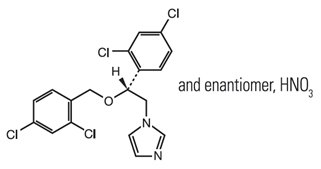
The zinc oxide has an empirical formula of ZnO and a molecular weight of 81.39.
The white petrolatum, which is obtained from petroleum and is wholly or nearly decolorized, is a purified mixture of semisolid saturated hydrocarbons having the general chemical formula C n H 2n+2 . The hydrocarbons consist mainly of branched and unbranched chains. White petrolatum contains butylated hydroxytoluene (BHT) as stabilizer.
Each gram of miconazole nitrate, zinc oxide and white petrolatum ointment contains 2.5 mg of miconazole nitrate, USP, 150 mg of zinc oxide, USP and 813.5 mg of white petrolatum, USP containing butylated hydroxytoluene, trihydroxystearin, and Chemoderm 1001/B fragrance.
Miconazole nitrate, zinc oxide and white petrolatum ointment is a smooth, uniform, white ointment.
CLINICAL PHARMACOLOGY
Mechanism of Action
The miconazole component of miconazole nitrate, zinc oxide and white petrolatum ointment is an antifungal agent [see Clinical Pharmacology (12.4) ] . The mechanism of action of white petrolatum and zinc oxide for the adjunctive treatment of diaper dermatitis is unknown.
Pharmacodynamics
The human pharmacodynamics of miconazole nitrate, zinc oxide and white petrolatum ointment is unknown [see Clinical Pharmacology (12.4) for fungal pharmacodynamics ] .
Pharmacokinetics
The topical absorption of miconazole from miconazole nitrate, zinc oxide and white petrolatum ointment was studied in immunocompetent male and female infants and children (n = 17) with diaper dermatitis complicated by documented candidiasis (microscopic evidence of pseudohyphae and/or budding yeast) ranging in age from 1 month to 21 months. After multiple daily applications to the affected area at every diaper change (approximately 5-12 times per day) for 7 days, the plasma concentrations of miconazole were below the lower limit of quantitation (LOQ) of 0.5 ng/mL in 15 out of 17 (88%) subjects. In the other 2 remaining subjects, the plasma concentrations of miconazole were 0.57 and 0.58 ng/mL, respectively at a single timepoint (4 hours after the last application) on Day 7.
Microbiology
The miconazole nitrate component in this product has been shown to have in vitro activity against Candida albicans , an organism that is associated with diaper dermatitis. The activity of miconazole nitrate against C. albicans is based on the inhibition of the ergosterol biosynthesis in the cell membrane. The accumulation of ergosterol precursors and toxic peroxides results in cytolysis of the cell. In vitro minimal inhibitory concentration (MIC) test results for C. albicans isolates obtained from treatment failures in Clinical Study 1 [see Clinical Studies (14) ] does not appear to indicate that resistance to miconazole nitrate was the reason for treatment failure. The clinical significance of the in vitro activity of miconazole nitrate against C. albicans in the setting of diaper dermatitis is unclear.
NONCLINICAL TOXICOLOGY
Carcinogenesis, Mutagenesis, Impairment of Fertility
The carcinogenic potential of miconazole nitrate, zinc oxide and white petrolatum ointment in animals has not been evaluated.
Miconazole nitrate was negative in a bacterial reverse mutation test, a chromosome aberration test in mice, and micronucleus assays in mice and rats.
Miconazole nitrate had no adverse effect on fertility in a study in rats at oral doses of up to 320 mg/kg/day.
CLINICAL STUDIES
Study 1 was a double-blind, multicenter study in which miconazole nitrate, zinc oxide and white petrolatum ointment was compared to the zinc oxide and white petrolatum combination treatment and included 236 infants and toddlers with diaper dermatitis, complicated by candidiasis as documented by KOH tests that demonstrated pseudohyphae and/or budding yeasts. Study medication was applied at every diaper change for 7 days.
The primary endpoint was “Overall Cure” and required that subjects be both clinically cured (total resolution of all signs and symptoms of infection) and microbiologically cured (eradication of candidiasis). Primary efficacy was assessed 1 week following the end of treatment, at Day 14.
Study results are shown in the following table.
Overall Cure at Day 14 | ||
Miconazole Nitrate, Zinc Oxide and White Petrolatum Ointment n = 112 | Zinc Oxide/White Petrolatum n = 124 | |
26 (23%) | 12 (10%) | |
Two additional studies provided supportive evidence of the clinical efficacy of miconazole nitrate, zinc oxide and white petrolatum ointment in infants and toddlers with diaper dermatitis, some of whom cultured positive for C. albicans . However, candidal infection was not documented in the culture-positive subjects, as microscopic testing (e.g. KOH) was not done. Therefore, the positive culture results may have reflected colonization rather than infection.
HOW SUPPLIED/STORAGE AND HANDLING
How Supplied
Miconazole Nitrate, 0.25%, Zinc Oxide, 15% and White Petrolatum, 81.35% Ointment contains 2.5 mg of miconazole nitrate, USP, 150 mg of zinc oxide, USP and 813.5 mg of white petrolatum, USP per gram. The smooth, uniform, white ointment supplied in an aluminum tube is available as follows:
NDC 0378-8222-50 carton containing one 50 gram tube
Storage Conditions
Store at 20 ° to 25 ° C (68 ° to 77 ° F). [See USP Controlled Room Temperature.]
Keep out of reach of children.
Mechanism of Action
The miconazole component of miconazole nitrate, zinc oxide and white petrolatum ointment is an antifungal agent [see Clinical Pharmacology (12.4) ] . The mechanism of action of white petrolatum and zinc oxide for the adjunctive treatment of diaper dermatitis is unknown.
